January 30, 2013

There, and Not There

Black-capped chickadees are one of my favorite birds.  I love their calls, especially their "chick-a-dee-dee-dee" call, and love to see them flitting about the woods.

They are so speedy that I can hardly ever get good pictures of them.

Here is my most recent effort:


And then, in the next instant, while I was still pressing the shutter button, he was gone:


January 29, 2013

January 28, 2013

Muskrat Habitat

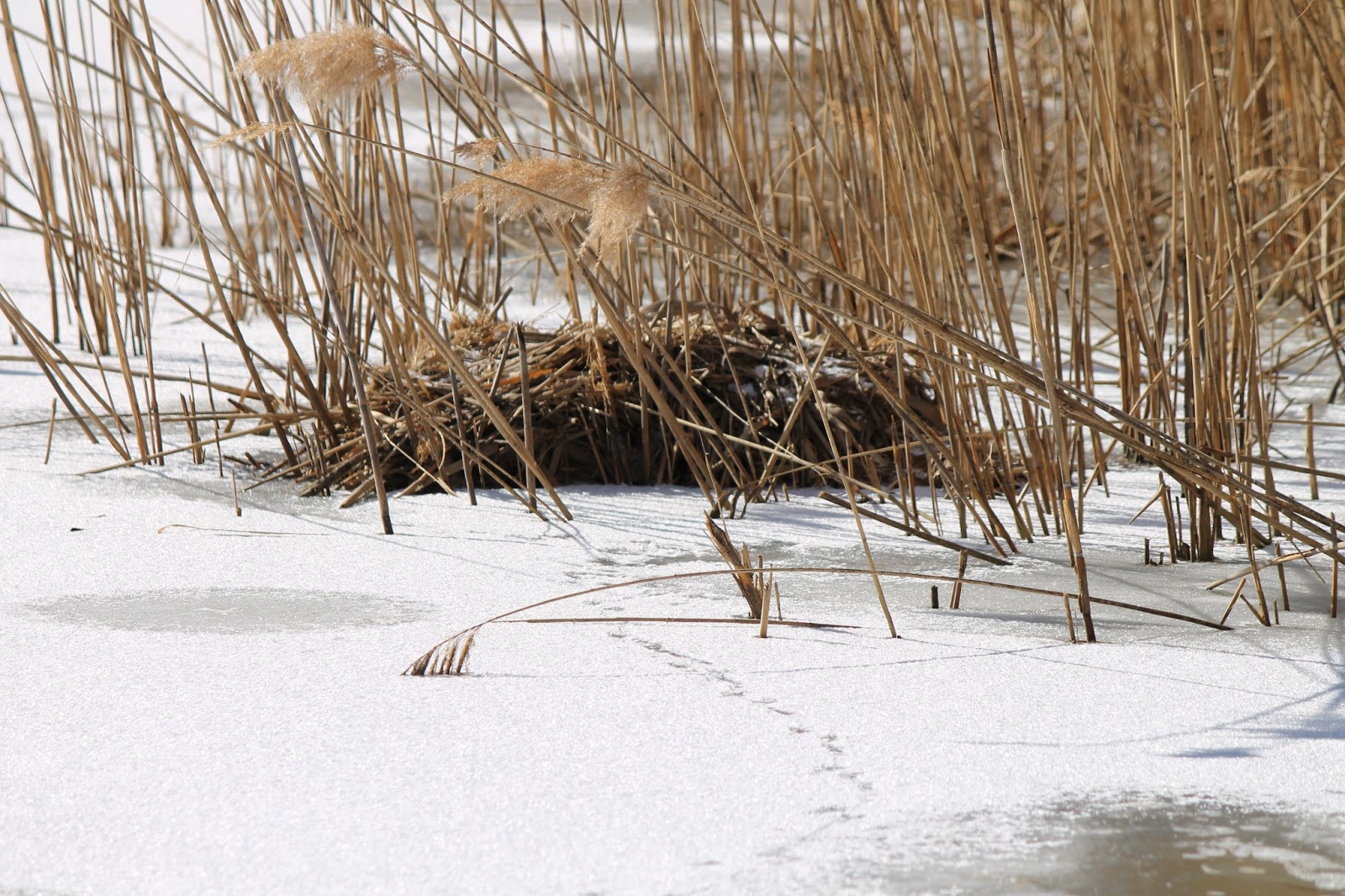
After finding a real muskrat at the park, I went back the next week to see if I could find him again.  No such luck.  But, I did find tracks, and a den!


That long line intermingled with the tracks, shown in these pictures, is made by the critter's long, thin tail as it drags on the snow behind him.


And here is his house, nestled on the front edge of the phragmites australis (the common reeds) on the pond. Some muskrat lodges have underwater entrances, but this one probably does not.


The muskrat can close his ears when swimming, and has partially webbed hind feet.  It likes to eat cattails and other marsh vegetation, but will also eat some small animals such as frogs.  They were, of course, once killed in great numbers for their fur.

January 25, 2013

Curiouser and Curiouser

These photos are from last year.

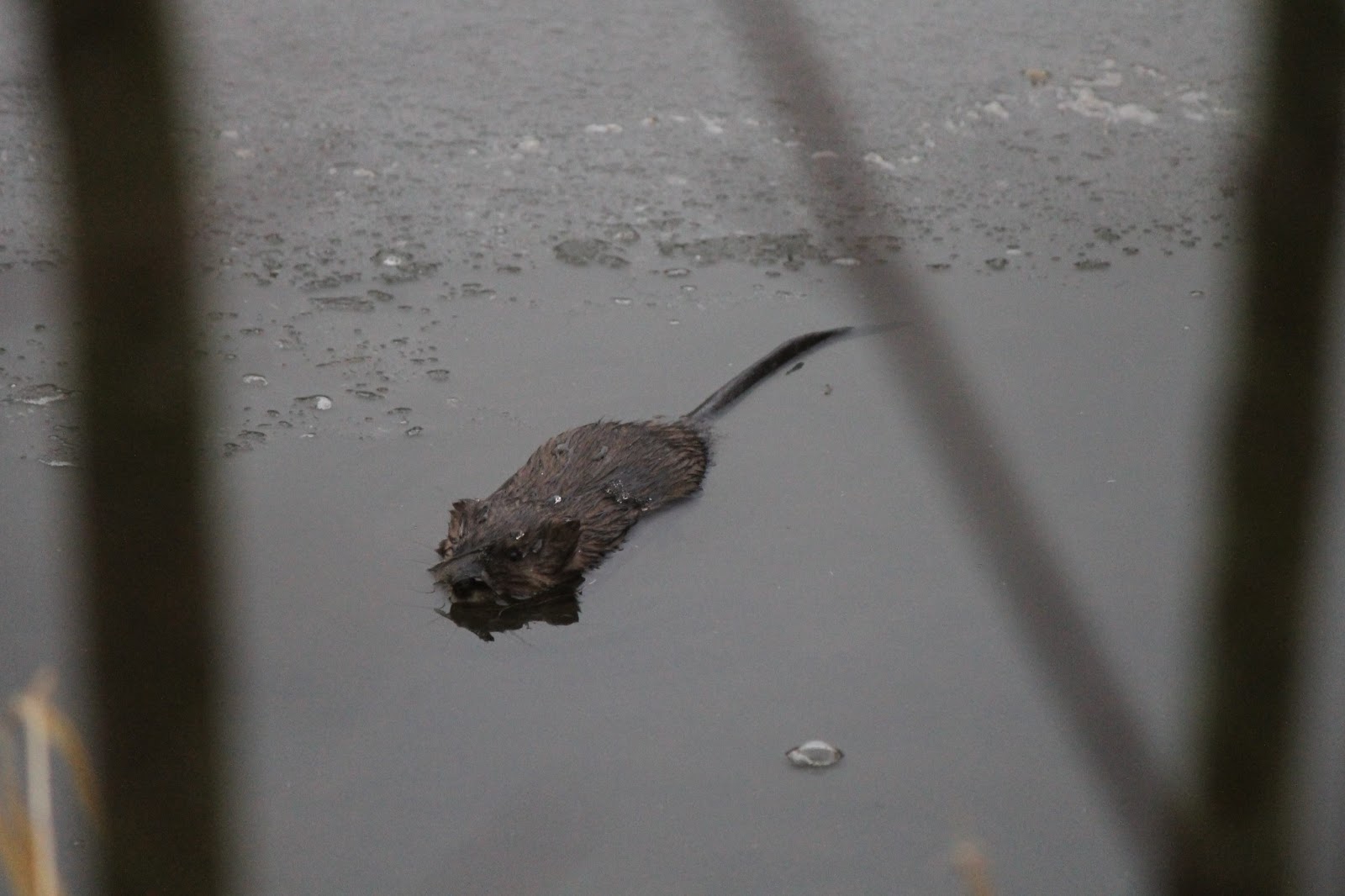
I was walking at the park when I heard a commotion in the pond - splashing and then a big "Glump!" Turning to look, I saw bubbles frothing to the surface, and a dark, submerged shape cruising toward me.

That was a little unnerving.  Normally animals swim away from people.

It got closer and closer, and then it surfaced a little bit.


I expected it to be a beaver, but it wasn't.


Silently gliding along the shoreline, it drifted around to face me.


 It was a muskrat!  (Check out the long, thin tail.  Beavers have wide, flat tails.)


I had the impression that he was curious about me, and was checking me out.

And really, what did he have to fear?  Yes, I walk upon two legs, but I carried no gun, and had no malevolent intentions.  And he was a master swimmer.  I could no more leap into his pond and catch him than he could break into my house and kidnap me at gunpoint.

And then he was gone, disappearing into his underwater demesne.  I was left with the thrill of the encounter, and these great photos of a muskrat with the face of a waterlogged scottie dog.

January 23, 2013

Old Lotus

I liked seeing these old lotus pods on the marsh in December.  They were past their prime, but still appealing in shape and design.


They adedd a splash of color to the muddy shallows,


... and provided a record of the water levels across their weathered fronts and hulls.

January 22, 2013

Oak Leaf Galls

Now showing:  Oak Leaf Galls.  Visually, they take these leaves from ordinary to eye-catching.


These are red oak leaves.  They have pointed bristles on the end of each lobe.  (White oak leaves, on the other hand, have blunt lobes and no bristles.)

The galls are created by gall wasps.

I've discussed galls before in my former post, "Pretty Galling".  You can find that here:
http://foundonthetrail.blogspot.com/2012/07/it-takes-lot-of-gall.html

Generally such leaf galls are harmless to the tree.  They represent an interaction between the leaf and the gall wasp - a part of life that left its mark.  Perhaps we could say that galls give the leaves a little more character.  I know that they sure caught my eye, and I was interested in the story behind the appearance.

January 21, 2013

Pileated Woodpecker

While hiking at Wildcat Den, my friends and I were treated to the sight of a pileated woodpecker.


This thing was big, and it was loud.  We first noticed it from the sound of its pecking on a tree, but then it swooped over us and flew up the trail a little ways, making a loud set of calls. I don't remember ever hearing a call quite like it.  Up to that point we had only seen small birds, like nuthatches and black-capped chickadees, all of which this woodpecker could have eaten for lunch!  The pileated is about a foot-and-a-half long, while those littler birds are only about six inches long.  It made quite an impression!


The bird takes its name from the red, hairy-looking feathers on its head.  Pileated means "crested" and comes from the Latin "pileatus" meaning "wearing a felt cap".  (Thank you, dictionary.com !)  This word is also related to the Latin "pilus", meaning "hair".


This particular pileated woodpecker happened to be a female.  How do I know?  According to my research, the males have a red line running from their bill to their throat, and on the females, this line is black.  You can see in this picture that ours has a black line.

The moral of the story?  Get out on the trail.  You never know what you might find!

November 5, 2012

Yard Birds

I chanced to look out the window the other day and saw a little downy woodpecker working over one of our crab apple trees like crazy.  I scanned the rest of the yard and saw several other birds flitting about.  That was enough for me.  Out I went with my camera.

Who needs to go far afield to photograph wildlife?  Not me, as it turned out.  I had plenty of activity right in my own yard.  Below are photos of the birds I managed to photograph.

Down Woodpecker

Junco

Catbird

Nuthatch

Robin

Cardinal

Blue Jay

Black-capped Chickadee

October 28, 2012

Time to Fly

Something Told the Wild Geese
by Rachel Field


Something told the wild geese
It was time to go,


Though the field lay golden

Something whispered, "snow."


Leaves were green and stirring,
Berries, luster-glossed,


But beneath warm feathers
Something cautioned, "frost."


All the sagging orchards
Steamed with amber spice


But each wild breast stiffened
At remembered ice.


Something told the wild geese
It was time to fly,


Summer sun was on their wings,
Winter in their cry.


October 27, 2012

Now We Know

It's funny how we see things and take them in unconsciously, but never really think about them on purpose.


For years I've seen large white splats on the ground while hiking shorelines.  ("Splat" - yes, that's a scientific word.)


Never gave them much thought.


Then one day while walking with Hyperion, he casually observed, "That's heron scat."


Oh!  So that's what that is!  Suddenly, I was seeing it everywhere.


Now I know, and so do you.  Next time we see such a deposit, we'll know that a heron recently shared the same bit of shoreline.

October 25, 2012

Hike at Maquoketa

Hiked at Maquoketa Caves last week with a couple of friends.  We had a grand adventure!  The day started off with snowflakes, white nose syndrome in bats, and a five-lined skink.  After leaving the ranger's office, we hiked through Dance Hall Cave and immersed ourselves in a wonderland of golden leaves.  Here are some photographic highlights:

Natural Arch

Looking out from Middle Dance Hall

Raccoon Creek running through Dance Hall


Gold spilling into the stream