Showing posts with label Davenport. Show all posts

November 1, 2013

Daddy Longlegs

Daddy longlegs are spiders.  That's the name that my family, friends and neighbors always used for them, anyway, but some people also call them granddaddy longlegs or harvestmen.  What do you call them?


They don't spin webs, and contrary to popular urban legends, they cannot poison you - no, not even if they were able to bite you between your toes where your skin is reportedly the softest.  (Check out snopes.com for more information on this, if you don't believe me:  http://www.snopes.com/critters/wild/longlegs.asp .)

They are still kind of creep, however, when they are in your house or in your tent at summer camp.  I have known them to strike fear into the hearts of otherwise perfectly normal and mentally sound people.


Interesting fact - if their legs get cut or torn off, they still jiggle and move afterwards.  Don't let that freak you out next time you come upon just such carnage!

August 21, 2013

Pollen Baskets

I came across a field of pea partridge the other day, out at Nahant Marsh.  It is such a pretty plant that I couldn't help but stand there and admire the beautiful yellow flowers and the perfect, feathery leaves with their alternately compound pairs of leaflets.  I've blogged about it before, here:

As I took in the beautiful field full of flowers, I noticed a bumblebee by the plants nearest me, quickly buzzing into blossom after blossom.  That guy was fast!  He would no more than stick his fuzzy head into one flower when he would be off to the next, lifting himself as if on an elevator made of air.

I realized there were a few more bees nearby.  And then, as I lifted my eyes across the tops of the plants, I realized that the whole field was percolating with thousands of bees.  That did my heart good!


I decided to see if I could photograph one of the bees.  They were so fast that it was hard to get a fix on them before they moved on.  They were often obscured by portions of the pea partridge plants.  Finally I got a few decent pictures.


Even with my naked eye I was able to distinguish a yellow glob on the hind legs of the bees.  "That  must be pollen," I thought  Sure enough.  What I was seeing, and what you can see in these pictures, is thousands and thousands of grains of pollen packed into the pollen baskets that these amazing creatures are equipped with.

According to my research, bumblebees basicly lick their front legs and then use their front legs to brush all the pollen from their head and body down to their back legs, where it is pressed into the pollen basket.

Based on the size of the pollen globule on this fellow, he's been hard at work!

You can see the yellow, dusty pollen coating this bee's head, legs and body.

August 20, 2013

Lucky Shot

I was photographing egrets and herons at Nahant Marsh the other day, and as usual, when I got home and examined my photos up close, I found I had captured some unexpected wildlife.  It was a lucky shot, really.  Take a look:


Yep!  My very first raccoons caught on camera, and I didn't even know they were there!  Cast your net upon the waters and you never know what you will find.


These carnivorous mammals look cute from a distance but trust me - they are vicious, destructive animals.  Campers beware!  Do not sleep with food in your tent.  If you do, you are just asking for trouble, and raccoons will bring it without a doubt.  Thankfully these two were eating natural foods, and not garbage from a dumpster.

August 19, 2013

A Whole Lotta Egrets!

Nahant Marsh is a local treasure-box of wildlife.  They recently posted on Facebook that they had had an "abundance" of egrets and heron lately.  I was able to get out there last Friday morning, and was delighted when I pulled up in the parking lot and saw this view:


How cool was that?  Five white egrets all right there.  I couldn't wait to get out on the dock and get some closer photos.  I hurried down the mowed path through the tall grass prairie and out onto the dock, intent on getting some awesome photos.  Click, click, click went my camera.  Such great shots!  And then I paused and looked off to the northeast end of the marsh.  Lo and behold!


Wow!  I was stunned by the sheer number of birds out there.  There were so many that I laughed out loud!  There were at least fifty egrets and herons, all mixed together at that end of the marsh.  I only had my zoom lens and so couldn't get a wide angle shot but here are some close-ups:


I think it is funny that I was so focused on the first five egrets I saw that I almost missed seeing ten times that number.  I wonder how often we are like that in life - just focusing in on what we think is the prize, when there's lots more in store for us if we just open our eyes and look around.

Nahant Marsh is a cool place. It used to be a private shooting club, and all that lead shot (tons and tons of it) began poisoning the animals in the marsh. Eventually it was dredged and restored.  Now it is an absolute gem, with a hugely diverse population of plants and animals.

Here's a link to the amazing cleanup story of the Nahant Marsh:
 http://www.fws.gov/contaminants/documents/nahant_web.pdf

May 13, 2013

Raspberry Plants

Raspberry plants.

They have jaggedy leaves.  Sometimes people mistake them for poison ivy.  There is a passing resemblance - both plants have leaflets in bunches of three, with basically the same shape.


And at times, both plants can have red stems or stalks.  However, only the raspberry is thorned.


When we see the springtime raspberry canes, we are reminded of the promise of fresh berries in June.  Yum!

May 9, 2013

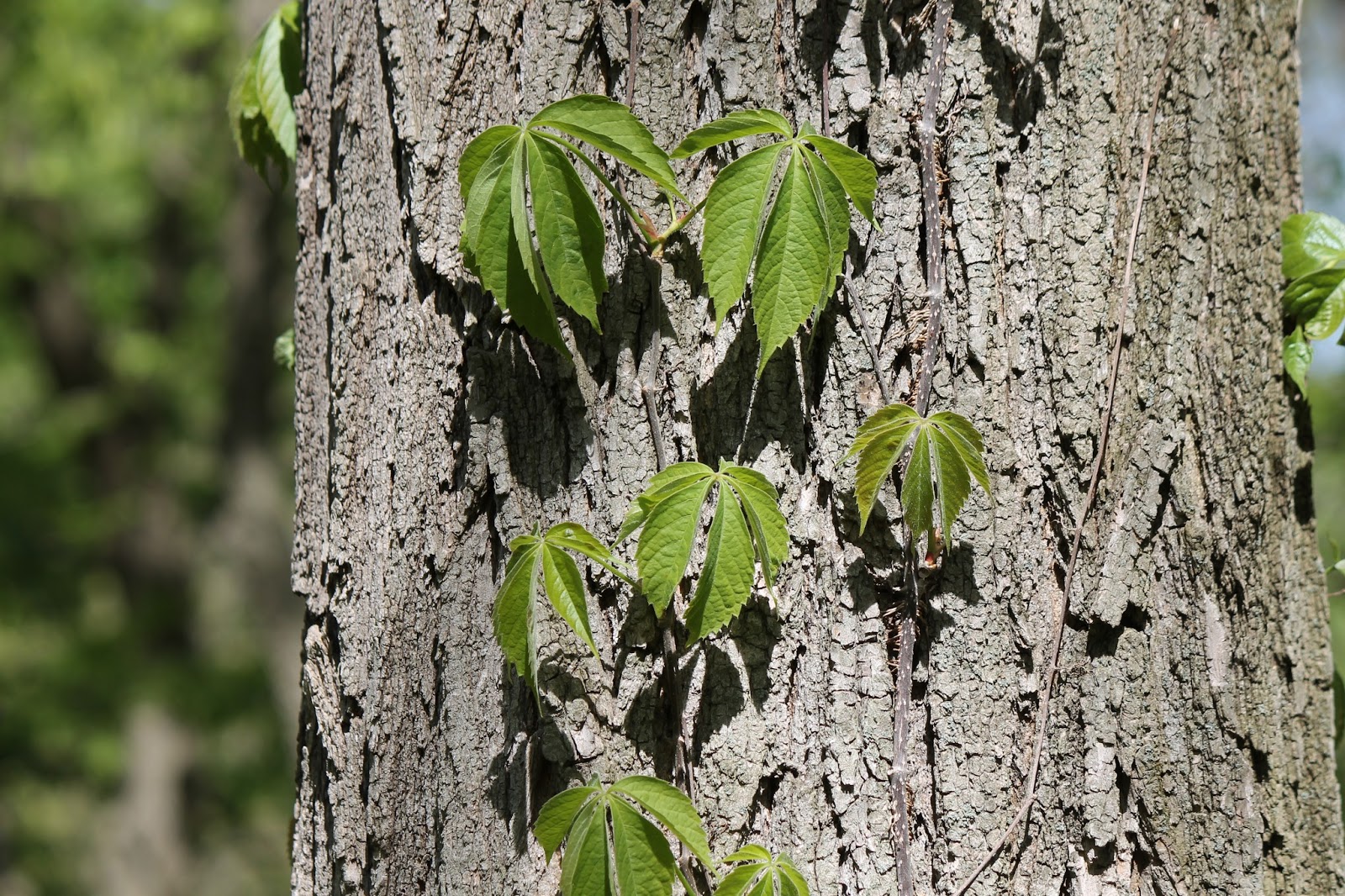
Virginia Creeper

This is Virginia creeper.


People sometimes mistake this plant for poison ivy, but a key difference is that Virginia creeper always has five leaves, and poison ivy only has three.

This plant is native to North America and is most often seen climbing trees.  It can grow along the ground as well.  It turns red in the fall, adding to the beautiful colorscape of the autumn woods and fields.

February 28, 2013

Black Ribbon

The Duck Creek bike path is a black ribbon,


inviting you to trace each curve running through the wintery woods, by foot or by tire.


October 2, 2012

Going Tharn

Watership Down is a book written by Richard Adams.  In that book, a group of rabbits leave their home warren and make their way in the world, encountering many challenges to their survival.  Adams included several words of his own invention to describe the rabbit culture in his story.  The word "tharn" is one of them.  It means frozen with fear, where a rabbit is so scared that he freezes on the spot and presses himself to the earth in spite of oncoming danger.  And that is exactly the word that popped into my head when I saw this rabbit.


He had gone tharn.  This rabbit was not eating, and he was not sleeping.  He could clearly see us, but made no move to run away.  In fact, he didn't move a muscle.  Everything about him - his behavior and posture - said "Stay away!"  Something was not right.

I wondered if he was truly just scared out of his wits, or if he was too sick or injured to move.  Rabbits do not usually sit still in plain sight and in close proximity to humans the way this fellow was.  Normally they hop away quickly to shelter, such as a nearby bush.


His ears were lying back in an unnatural way and it was pathetic. in the true sense of the word, to see him display this odd behavior.  We quickly left the poor creature alone, so as not to traumatize him any further.  When we came back through about an hour later, he was gone.    

September 28, 2012

Pretty Pea Partridge

Pea partridge is one of my favorite native plants of all time.  I was first introduced to it at Nahant Marsh three years ago, and we have been friends ever since.

It has small yellow flowers on reddish stalks, with reddish-brown centers.  Its long leaves are made up many compound leaflets.  Once we met, I began seeing it everywhere.


Pea partridge can grow in thick clusters, providing superior cover for birds and other wildlife, which can move easily through these stands.  Such ease of movement is not possible through stands of similar but invasive plant species.


Pea partridge is a plant we can be really happy about.  It is pleasing to the eye, and good for the soil.  It is important in honey production, and as a food source and egg depository for butterflies such as the common sulphur.  It is also eminently useful to larger wildlife.


The pea pods ripen by late fall.  They eventually burst, and there small black seeds are dispersed.  The cool thing about these seeds is that they are highly waterproof, helping them to last well through the winter months.  Not only do they winter well, but they are high in protein and low in fiber, making them easily digestible - perfect for bobwhites and other game birds.

September 16, 2012

Past Trails: Nature Study Group

When my boys were younger, we got involved in a wonderful nature study group as part of our homeschool.  We met every Friday, and explored some wild place in the area, often sketching what we found.  Sometimes formal lessons were taught by youth and adults in the group, and by expert in the community.  Other times the lessons came from impromptu teaching moments on the trail.

We hiked at Wildcat Den, studied Indian burial mounds at Albany Mounds, went letter boxing and geocaching, hiked in the snow at Scott County Park, and studied mussels at Pigeon Creek.  We climbed muddy hillsides at Illiniwek Forest Preserve, observed birds and learned about native plants and turtles at Nahant Marsh, and had a presentation on bats by a Davenport parks & rec. instructor.  We studied geographic features at Black Hawk State Park, caught toads and frogs at Eastern Avenue Park, and laughed our heads off over a ferret video in LeClaire.  We made mint tea at Devil's Glen Park, studied animal gaits and went snowshoeing at the Wapsipinicon Environmental Center, and visited the Vander Veer Botanical Gardens multiple times.  We studied rocks and fossils at the Fryxell Geology Museum, went start gazing at Augustana College observatory, studied snow at Crow Creek park, and attended a star program at the Bettendorf High School Planetarium.  These were just some of our outings.

Here's a picture of the group one spring day in 2008 at Credit Island.  I remember this day.  It was beautiful out, and we took a long walk at the tip of the island.  We saw American White Pelicans and soaked up the sunshine and camaraderie.

Nature Study Group, Credit Island, April 2008

These weekly outings rekindled my interest in the natural world, and helped me appreciate the beauty around me which God has created.  This group was a lifesaver for me, and a delight.  I loved getting out, and meeting the other ladies, and seeing all of our kids playing together.  Friendships were formed in this group that still remain today.

August 4, 2012

A Real Creeper

Can you see the creeper?


Not that kind of a creeper!  This is a friendly little guy who creeps up (but not down) trees and eats the insects hiding in the bark.  When he gets to the top, he flies to the base of another tree and starts working his way up again.


Here's a close up of him.  He's a brown creeper - Certhia americana.


Brown creepers are notorious for blending in well with tree bark they spiral up trees looking for their three squares a day.  Their bills have a slight curve to them, and they use their tails to lean on when working the bark.

July 28, 2012

Marshy Artwork

Besides the beautiful plants and animals at Nahant Marsh, they also have some of the still life variety, painted on the observation blind.  I don't know who the artist was, but I really like the art.  Here are a couple of closeups.


And here's the big panorama.  How many of these creatures can you name?


(Click on the photo to enlarge it.)

July 5, 2012

Wild Phlox

Phlox is a native plant we can delight in.  There are many forms and colors, including red, and they can be found from the woodlands to the prairies to the alpine tundra.


Beloved of groundhogs, rabbits, and deer, their leaves also provide food for moths.


These were so pretty that I took dozens of photos of them.  The blue and purple ones were my favorite.  And I loved the little star shape in the center of each flower.


The word phlox comes from the Greek indicating a flame-colored plant.  It literally means "flame".

June 23, 2012

Spring Beauties

These are Spring Beauties.


If you see this little wild flower, than you know that spring has definitely arrived.  They like the dappled sunlight and the rich soil to be found in undisturbed woodlands.


Believe it or not, these tiny little flowers have edible tubers that can be cooked just like potatoes.  They are sometimes called "fairy spuds".  They are quite small.

I love their beautiful starry shape, and gorgeous, delicate stripes.


Euell Gibbons, author of Stalking the Wild Asparagus, wrote, "The tubers are good food for the body, but after a long winter, the pale-rose flowers in early spring are food for the soul."  Indeed.

Friends

Sometimes it is good to be alone in the woods, and contemplate the beauty of the world, and our purpose in being here.  There is time and space for quiet reflection and soul searching.


Other times it is good to have a friend with us.  Nothing can replace a good friend, who will sit and listen when we need to talk.  They help us process the perplexities of the world, and our experiences in it.


I'm thankful for all the "trail buddies" in life.

"Ointment and perfume rejoice the heart: so doth the sweetness of a man's friend by hearty counsel."  Proverbs 27:9