Showing posts with label McLammarah Park. Show all posts

February 7, 2013

Winter Sustenance

What's that in the snow?


It's pale yellow, and a bit  pulpy.  Any guesses?


Looks like pale broccoli - but it's not.


It's an Osage Orange that has been chewed to bits, probably by a squirrel, for a little winter sustenance.  Mmm, mmm, mmm!

January 30, 2013

There, and Not There

Black-capped chickadees are one of my favorite birds.  I love their calls, especially their "chick-a-dee-dee-dee" call, and love to see them flitting about the woods.

They are so speedy that I can hardly ever get good pictures of them.

Here is my most recent effort:


And then, in the next instant, while I was still pressing the shutter button, he was gone:


January 28, 2013

Muskrat Habitat

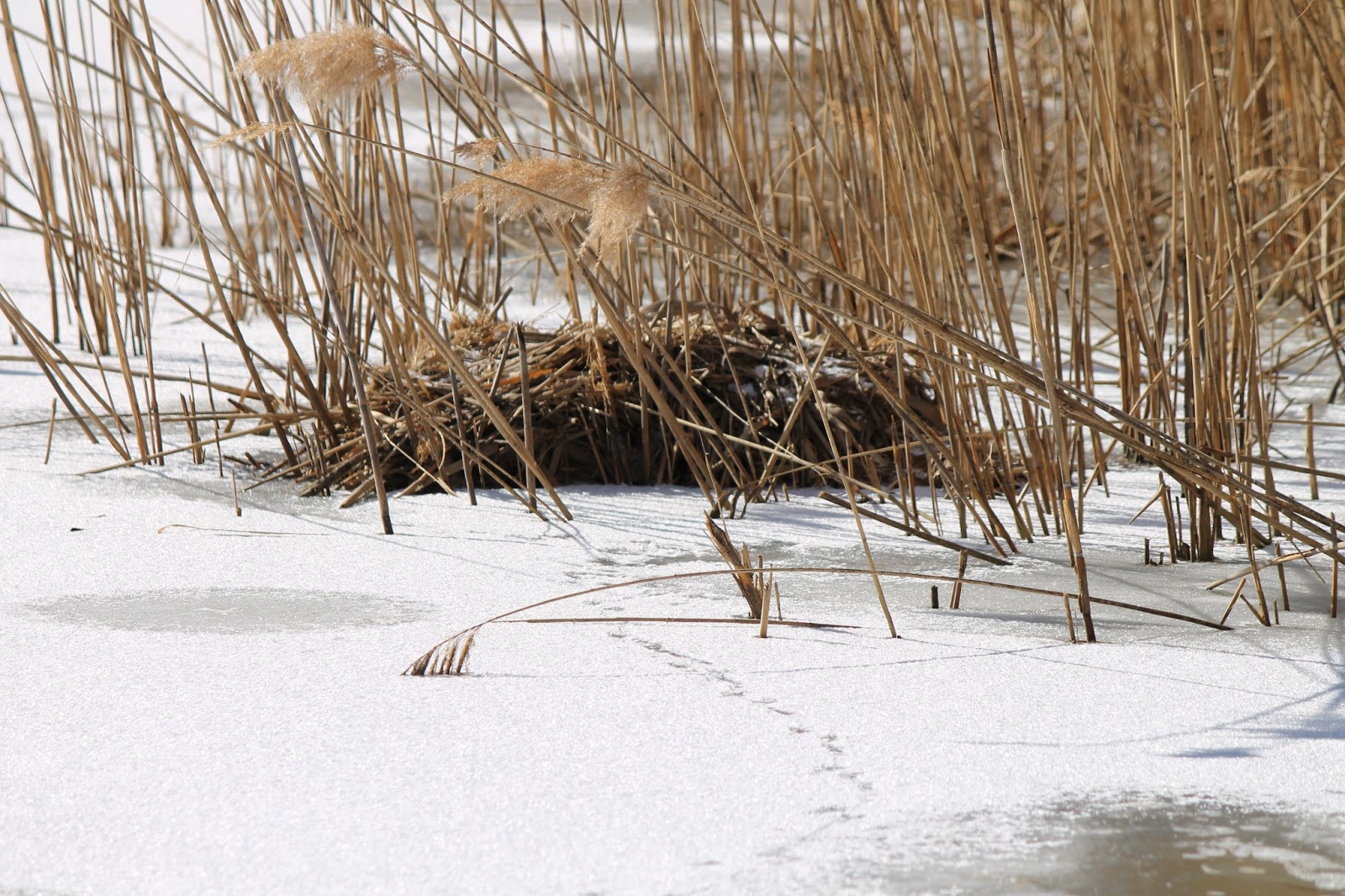
After finding a real muskrat at the park, I went back the next week to see if I could find him again.  No such luck.  But, I did find tracks, and a den!


That long line intermingled with the tracks, shown in these pictures, is made by the critter's long, thin tail as it drags on the snow behind him.


And here is his house, nestled on the front edge of the phragmites australis (the common reeds) on the pond. Some muskrat lodges have underwater entrances, but this one probably does not.


The muskrat can close his ears when swimming, and has partially webbed hind feet.  It likes to eat cattails and other marsh vegetation, but will also eat some small animals such as frogs.  They were, of course, once killed in great numbers for their fur.

January 25, 2013

Curiouser and Curiouser

These photos are from last year.

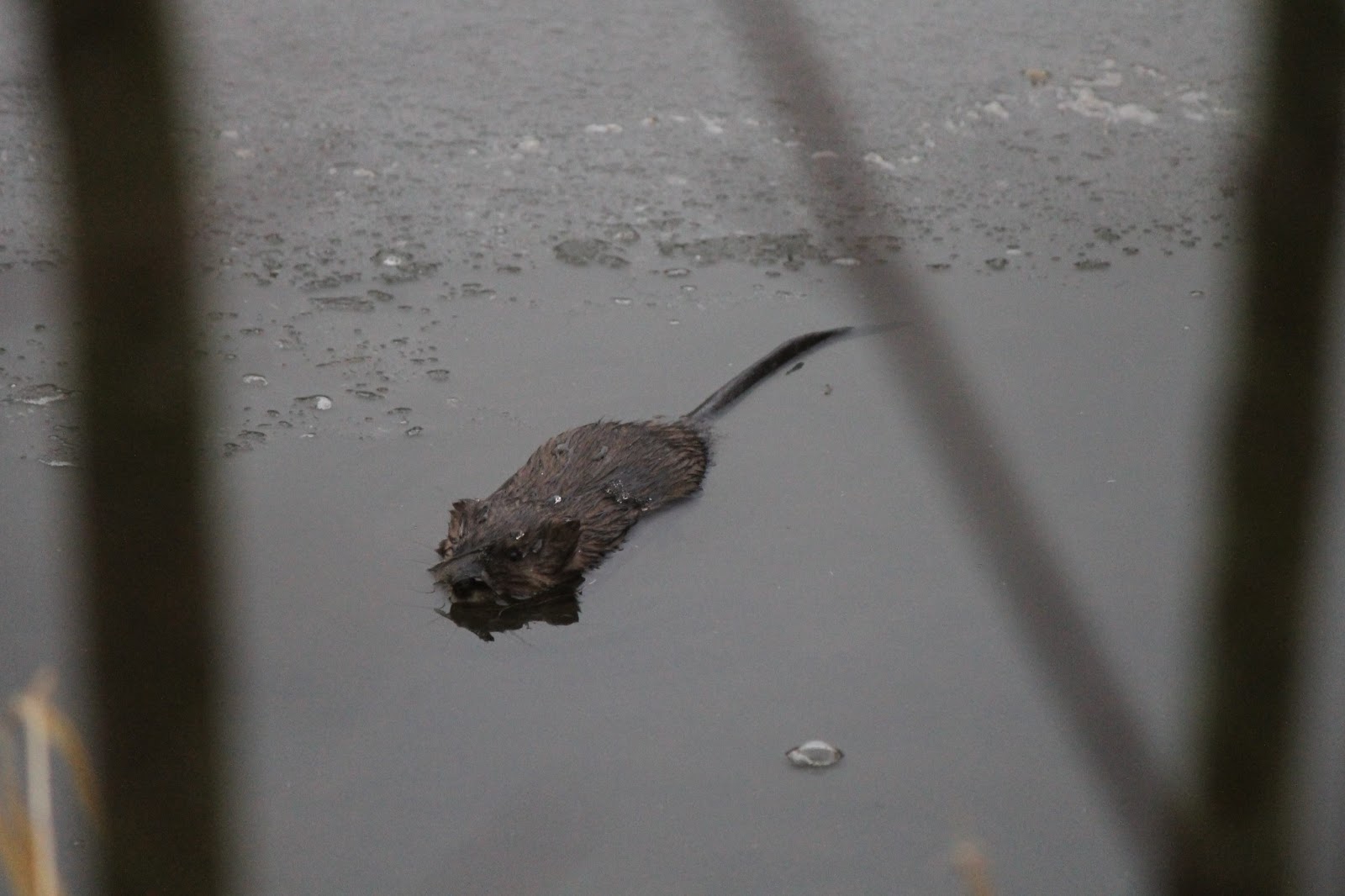
I was walking at the park when I heard a commotion in the pond - splashing and then a big "Glump!" Turning to look, I saw bubbles frothing to the surface, and a dark, submerged shape cruising toward me.

That was a little unnerving.  Normally animals swim away from people.

It got closer and closer, and then it surfaced a little bit.


I expected it to be a beaver, but it wasn't.


Silently gliding along the shoreline, it drifted around to face me.


 It was a muskrat!  (Check out the long, thin tail.  Beavers have wide, flat tails.)


I had the impression that he was curious about me, and was checking me out.

And really, what did he have to fear?  Yes, I walk upon two legs, but I carried no gun, and had no malevolent intentions.  And he was a master swimmer.  I could no more leap into his pond and catch him than he could break into my house and kidnap me at gunpoint.

And then he was gone, disappearing into his underwater demesne.  I was left with the thrill of the encounter, and these great photos of a muskrat with the face of a waterlogged scottie dog.

September 21, 2012

Common Reed

The scientific name for the common reed is not so common.  In fact, it's a lot of fun to say.  It is "Phragmites australis".  Say it.  Say, "Phragmites!"

Summer

The common reed, which is very tall and grows in wetlands, is one of the most common plants worldwide.  The only continent where you can't find it is - you guessed it - Antarctica.

Summer

It has been used to make thatched roofs for cottages, baskets, mats, musical instruments, brooms, arrows, and spears.  It has also been a food source for humans and animals.

Winter

There are two basic kinds of Phragmites australis here in North America.  Invasive, and non-invasive.  The invasive kind seems to have started along the eastern seaboard and worked it's way west, as with so many other invasive species.

Winter stand

I have no solid idea which kind I have captured in these photographs.  They are difficult for a layman like me to tell apart.  The native species usually grows in less dense stands, has lighter leaf coloring, and more red coloring along the nodules and stems.

For an excellent field guide on this matter, go to the following web address:

http://www.nps.gov/plants/alien/fact/pdf/phau1-powerpoint.pdf

The two women who wrote this treatise, Jil Swearingen and Kristin Saltonstall, have done a superior job in their writing and their use of photographs and drawings.

May 24, 2012

Early Blossoms

Every time I take a walk, I see something new and different.  This is true even if I have been to that place a dozen times before.  And this time it was the giddy display of trees in spring bloom along the trail.


Not only did these beautiful blossoms look pretty from a distance, dressing the long-naked trees in soft while petticoats, but up close they presented a whole new display to dazzle the eye.


To the best of my knowledge, these are ornamental pear tree blossoms.  They were beautiful in the morning sunlight, and I only wished my camera could reach further into their intricate structures so that I could marvel more at their amazing design and perfect beauty.