There are 4 federally endangered mussels on the Mississippi. They are the Winged Mapleleaf, Higgin's Eye Pearlymussel, Fat Pocketbook, and Scaleshell.
Federally endangered means they are in real danger of going extinct. A lesser designation would be "threatened".
Why should we care? Because mussels filter millions of gallons of water each day. They keep our water clean.
What can we do to help? For starters, we can learn about an exotic species that has invaded our waterways, and that is the Zebra mussel. They grow thick and fast, and can carpet the bottom of rivers, choking out the native mussels. Zebra mussels also attach themselves to the bottom of boats, which is one way they are spread - being transported from lake to lake or river to river. If you are a boat owner, you can inspect your craft and clean it off every time you come off the water.
Showing posts with label Mollusks. Show all posts
Showing posts with label Mollusks. Show all posts
June 5, 2012

Handsome Mussels
It's always exciting to be walking along a shore and find shells - whether it is an ocean beach or a river bank. Around here, you can find freshwater mussels. The trick to further enjoyment is learning to identify them.

As I have tried to master this task, I have delighted in their odd and descriptive names: Washboard, Spike, Elktoe, Ebonyshell, Sheepnose, Wabash Pigtoe, Pistolgrip, and my personal favorite - the Purple Wartyback.

I haven't yet learned to identify them, so I'm just sharing some pictures of mussels here as things of beauty.


And yes, I can't help but add a little etymological nugget. As you might guess, "mussel" comes from the word "muscle", but THAT word comes from the Latin "musculus" which means "little mouse". How's that for cute?

As I have tried to master this task, I have delighted in their odd and descriptive names: Washboard, Spike, Elktoe, Ebonyshell, Sheepnose, Wabash Pigtoe, Pistolgrip, and my personal favorite - the Purple Wartyback.

I haven't yet learned to identify them, so I'm just sharing some pictures of mussels here as things of beauty.


And yes, I can't help but add a little etymological nugget. As you might guess, "mussel" comes from the word "muscle", but THAT word comes from the Latin "musculus" which means "little mouse". How's that for cute?
May 24, 2012
Evidence of Wild Animals
I am a scouter, and one of my favorite requirements to help the scouts with is to identify evidence of at least 10 kinds of wild animals. I love seeing the boys out in the woods, noticing things they've never noticed before, and getting excited about how much they can deduce on their own.
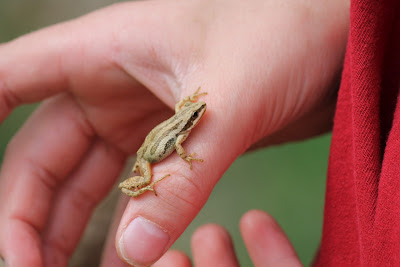
The first morning started off well right at the campsite. The boys found this torpid amphibian, and some deer guard hairs. We also heard several bird calls and saw evidence of squirrels having feasted on nuts.


Next we went out on a hike. We took to the miles of woods and fields on our scout camp property. We had 2 adults and 22 scouts. It seemed like everyone was noticing everything - tracks, scat, calls, and animal homes.

The rank requirement says to find evidence of animal life, including birds,


mammals,


reptiles,

fish, and mollusks.

The most exciting find of the day was a deer carcass. The boys swarmed it like bees - "Wow!" - "Cool!!!" We guessed at what might have brought it down. Disease? Bow hunters? Coyotes? We had heard them (the coyotes that is) yipping and wailing in the night. They might have done the deed earlier in the year.

It seemed like everywhere we looked, we found some new critter, or part of one!

(Note: No crawfish were injured in the production of this blog post. This one, who lost his claw, was already dead before we found it.)
My personal favorite on this hike was evidence left behind by a yellow-bellied sapsucker (isn't that just fun to say?), as seen on this tree trunk, where it "drilled" these holes to get at the sap. Pretty cool.

We got caught in the rain near the end of the hike, and had to shelter for a while under a fortuitously nearby structure, but it was still a wonderful hike. I think we all had our interest in the outdoor world rekindled.
The first morning started off well right at the campsite. The boys found this torpid amphibian, and some deer guard hairs. We also heard several bird calls and saw evidence of squirrels having feasted on nuts.


Next we went out on a hike. We took to the miles of woods and fields on our scout camp property. We had 2 adults and 22 scouts. It seemed like everyone was noticing everything - tracks, scat, calls, and animal homes.

The rank requirement says to find evidence of animal life, including birds,


mammals,


reptiles,

fish, and mollusks.

The most exciting find of the day was a deer carcass. The boys swarmed it like bees - "Wow!" - "Cool!!!" We guessed at what might have brought it down. Disease? Bow hunters? Coyotes? We had heard them (the coyotes that is) yipping and wailing in the night. They might have done the deed earlier in the year.

It seemed like everywhere we looked, we found some new critter, or part of one!

(Note: No crawfish were injured in the production of this blog post. This one, who lost his claw, was already dead before we found it.)
 |
| Photo credit: Jason |
All of the animals and evidence were left where they had been found, even though this practice was a hard sell for some of the scouts.

My personal favorite on this hike was evidence left behind by a yellow-bellied sapsucker (isn't that just fun to say?), as seen on this tree trunk, where it "drilled" these holes to get at the sap. Pretty cool.

We got caught in the rain near the end of the hike, and had to shelter for a while under a fortuitously nearby structure, but it was still a wonderful hike. I think we all had our interest in the outdoor world rekindled.
Subscribe to:
Posts (Atom)