August 1, 2013

Spotted Sandipiper

I was walking along the Mississippi River yesterday, and saw a streak of movement against the muddy shoreline.


When I turned to look more closely, it wasn't there.


This happened again and again until I realized that there were some little birds dashing about who were perfectly camouflaged.

Here are the same two pictures, with the fledglings circled.


It was a nest of little spotted sandpipers.  They slipped away up the shore and I was left with just a few fleeting glimpses.


An ever watchful parent was not far away - probably the dad, since they do the raising of the little ones.


Thankfully I had a couple of clear enough shots that I could I.D. the birds.


Spotted sandpipers are one of the most easy shorebird to identify - luckily for me.  Their spotted breast (prominent during mating season) and the white and black eyelines help distinguish them from other sandpipers.

July 31, 2013

Tempting Teasel

Are those frosted cupcakes out in that field, atop the tall grasses?

Teasel Cupcake

No, those are teasel pods with the blossoms forming a mirage of baked sweets.


Teasel is considered an invasive species.  It was brought to North America as an ornamental, and possibly for use in the woollen industry.   (Dried teasel pods were used to raise the nap of woollen fabric in the old world.)


The fanciful images of these coned pods caught my attention.  I have seen them brown and dried in the winter, but had never seen them in bloom before, which happens in July and August.

Wedding Cake Teasel

Teasel is a biennial plant.  In the first year of its growth, it forms a large rosette of leaves on the ground.  The second year, these tall spikes grow, averaging around six feet in height.  Such large and aggressive growth crowds out the natural species that would otherwise grown in their place.


July 30, 2013

The Nose Has It!

Birds have external nostrils, called nares.  They are not always obvious, but in this picture of a seagull below, you can see the bird's left nare quite clearly.  It is the oval-shaped hole in the upper beak.


Seagulls and a couple of other bird families have unique nares, in that you they don't have a dividing wall between them (a septum).  So in gulls, like this one, you can look through one nostril and clear through to the other side.

Some birds, like adult cormorants, don't have functional nares.  This makes sense, because they are constantly diving and it wouldn't be healthy for water to flood their respiratory system through an open nare.

Most birds seem to have exposed nares, but some are covered with feathers.  The ptarmigan is one of these.  The theory behind this is that the feathers help warm the frigid, arctic air where ptarmigans live before being taken into the body.

July 29, 2013

Beaks & Bills - Part 3

Continuing in my series on beaks and bills, we are going to take a quick look at woodpeckers and pelicans today.


Woodpeckers obviously have specialized beaks.  They are short, strong, and chisel-shaped - perfect for pecking holes in trees.  They also use these tapered beaks to get  into and under the tree bark in order to find insects to eat.

Yellow-bellied sapsuckers, who are in the woodpecker family, use their beaks to "drill" holes into trees until they can get to the sap running underneath.  Rather than sucking up the sap, as their name erroneously implies, they lap up the sap with their tongues.  (For a picture of their handiwork, go to this previous post:of mine, "Evidence of Wild Animals" and look at the last photo in the post, here:   http://foundonthetrail.blogspot.com/search/label/Amphibians .)
.
Compare those little beaks to the relatively enormous beaks of pelicans.  Pelican beaks have a flexible lower portion that can stretch and contract.  Look at the difference in beaks between these two pelicns in this picture below:


The lower bird has its beak neatly "folded", while the upper bird has just finished dipping his beak into the water, which is how they fish.  They scoop up fish and water - up to three gallons at a time.  The water drains out and the fish remain.

July 27, 2013

Beaks & Bills - Part 2

As I said in yesterday's post, some bird beaks are shaped to tear, such as this one (below).  This bald eagle was injured and is now a resident at a local zoo.  That is the only reason I was able to get such a clear shot of its beak with my camera.  You can see the sharp, pointed hook on the curved tip of the upper beak - the perfect tool to help birds of prey open their meals.  You also get a sense of how powerful this bird's beak really is when you look at it up close like this.


On the other hand, some birds have long, spear-like beaks, such as this great blue heron (below).  Heron's need such long, sharp bills for their water fishing.  They can actually spear their prey (usually fish) with their powerful, tapered beaks.

Their beak fits their carnivorous dietary requirements and their watery habitats.  That is why a much smaller, cone-shaped bill, such of that of the seed-eating grosbeak, wouldn't work on the heron.  Seeds are not generally what they are after. although they do consume them at times.


July 26, 2013

Beaks & Bills - Part 1

Can you identify this bird?  I couldn't, at first.  When I photographed it, it was too far away in the trees for me to see it properly.  When I saw this picture up close, thanks to the zoom feature in my photo program, I still had to stop and think about it.  The most easily identifiable feature of this bird was hidden from view on its breast, but I didn't know that.

The back view of this bird was not familiar to me.  All I could see was a black-head bird, a black back with white feathers, and whitish side breasts.  Woodpeckers have black and white backs, but this bird wasn't shaped like a woodpecker.  It was more round.  The beak really gave it away.  It is more massive than a woodpecker's beak.  Sure enough, when I did a little research, I was able to confirm that this is a Red-breasted grosbeak.

Had I seen it from the front, I would have been able to identify it very quickly.  To see what I mean, look here:  http://foundonthetrail.blogspot.com/search/label/Rose-breasted%20Grosbeak .


"Beak" is self-explanatory, but what about "gros"?  It comes from French, and means large, or thick.  Cardinals have this same powerful, cone-shaped beak.  It is a great for cracking open seeds, which is the main part of their diet.

Now take a look at this wren's bill, below.  ("Beak" and "bill" can be used interchangeably, but beaks are more for tearing, like an owl would do with their prey, and bills are more for catching insects from the air.)  You can see how thin and elongated this wren's bill is, compared to the grosbeak above.


Beak and bill shapes can reveal a lot about a bird's diet, and are key features to observe when you are trying to identify birds.

July 25, 2013

What's There?

There's lots of foliage here in Iowa, and it makes for good hiding for wild creatures.  You never really know what's out there in it.  You drive by a little stand of trees or walk in a city park, and for the most part you are completely unaware of what is hiding just a few feet from you.

Take a look here.  What do you see?


Bedded down in those cool green weeds is one of the larger North American mammals - a whitetail buck.  See him?  You can just make out parts of his antlers in the lower left-hand portion of the picture.

When I took the picture above, I couldn't see him, but I knew he was there.  He had just startled a little, when a nearby man clapped his hands together to call for his dog.  The noise cause the deer to raise his antlered head a little, and turn toward the sound.  I tried to get him in my viewfinder, but he had already sunk back into the weeds.

I stepped closer, trying to see where he was.  He raised his head up and looked around, directly at me.  Suddenly I was thinking of all those heedless tourists in Yellowstone Park who approach wild elk, bison and bears, and get trampled, gored and mauled.


As I wondered how just how many feet actually separated us, he rose and stared straight at me.

Deer have been known to attack humans, although it is rare.   You should not mess with them during mating season, or in the spring when they have their fawns, or with a sick or injured animal, or anytime, really.

To tell the truth, I was surprised that this one had not simply turned tail and run away, which is what they usually do.  That made me a little nervous.  I thought about the heat wave we'd been having, and how sever heat can cause wild animal great distress, making them even more unpredictable than usual. 


I did not approach any closer, or do anything startling.  After checking me out for a minute, he casually leapt over the log behind him, and disappeared.

There wasn't much place for him to go.  As I found out when I checked the location on Google Earth later, he had been hiding  in a narrow island of trees running between two rows of houses, in the midst of urban sprawl.  Makes you wonder what else is out there, so close by and yet unseen.

July 24, 2013

American Bellflower

This pretty flower is the American bellflower - also known as the tall bellflower.  I've passed these native wildflowers many a time on the trail at camp while walking from Eco-Con to the council ring, not knowing what they was but always admiring their color.  Today, I finally looked them up!


As you can see, they have five petals, all coming together in a white, inner ring.  The blossoms grow on long stalks, and range in color from light blue to purple.  That's one reason I like these beautiful bolts so much - those are some of my favorite colors!


It is unique in that it is not as bell-shaped as most other flowers in its group.  It's scientific name, Campulastrum americana, is taken from the Latin "campana", which means "bell".

July 23, 2013

Chillin'!

Last week we were suffering heat waves and warnings all over the state.  That's when I happened to get a picture of this guy:


We were visiting Grinnell College in central Iowa.  It was 92 degrees, and we were all baking in the sun as we took a walking tour of the campus.  But this squirrel had it figured out.  He sprawled himself against the relatively cool bark of this tree, enjoying what shade was to be had.  Staring at me with a glassy look, he did not seem phased when I turned paparazzi on him.


Adding to the humor of the moment were these Dr. Seuss -like "sweaters", adorning the trees in this little park on campus.  It made me chuckle to see this chillin' Grinnellian and these multi-colored tree adnorments.

July 22, 2013

Multiflora Rose

Due to the wet spring we had here, the raspberries were at least two weeks behind when we arrived at summer camp.  No trailside snacking for me this year!  However, this meant that there were new sights and smells to be enjoyed, such as the blossoms and fragrance of the wild rose.


I have not noticed such an abundance of wild roses before.  There were so many of them, that the sweet smell of their blossoms wafted through the air and attracted my attention as I walked the camp trails.

The wild rose, like the raspberry cane, has thorns, and sometimes a reddish stem.


This scrubby multiflora rose is an invasive species.  It was brought here in the mid-1800's from Asia, and spread pretty much like wild fire.  I've rarely taken a walk in the woods where I haven't seen them.  Farmers try to combat them, but no matter how many times you mow them down, and no matter how much livestock you have in a pasture trampling them, they keep coming back.


In spite of knowing how much trouble they can be, I couldn't help but enjoy them.  And they do have a benefit.  Birds and even deer will eat the rose hips that form later in the season.

May 13, 2013

Raspberry Plants

Raspberry plants.

They have jaggedy leaves.  Sometimes people mistake them for poison ivy.  There is a passing resemblance - both plants have leaflets in bunches of three, with basically the same shape.


And at times, both plants can have red stems or stalks.  However, only the raspberry is thorned.


When we see the springtime raspberry canes, we are reminded of the promise of fresh berries in June.  Yum!

May 9, 2013

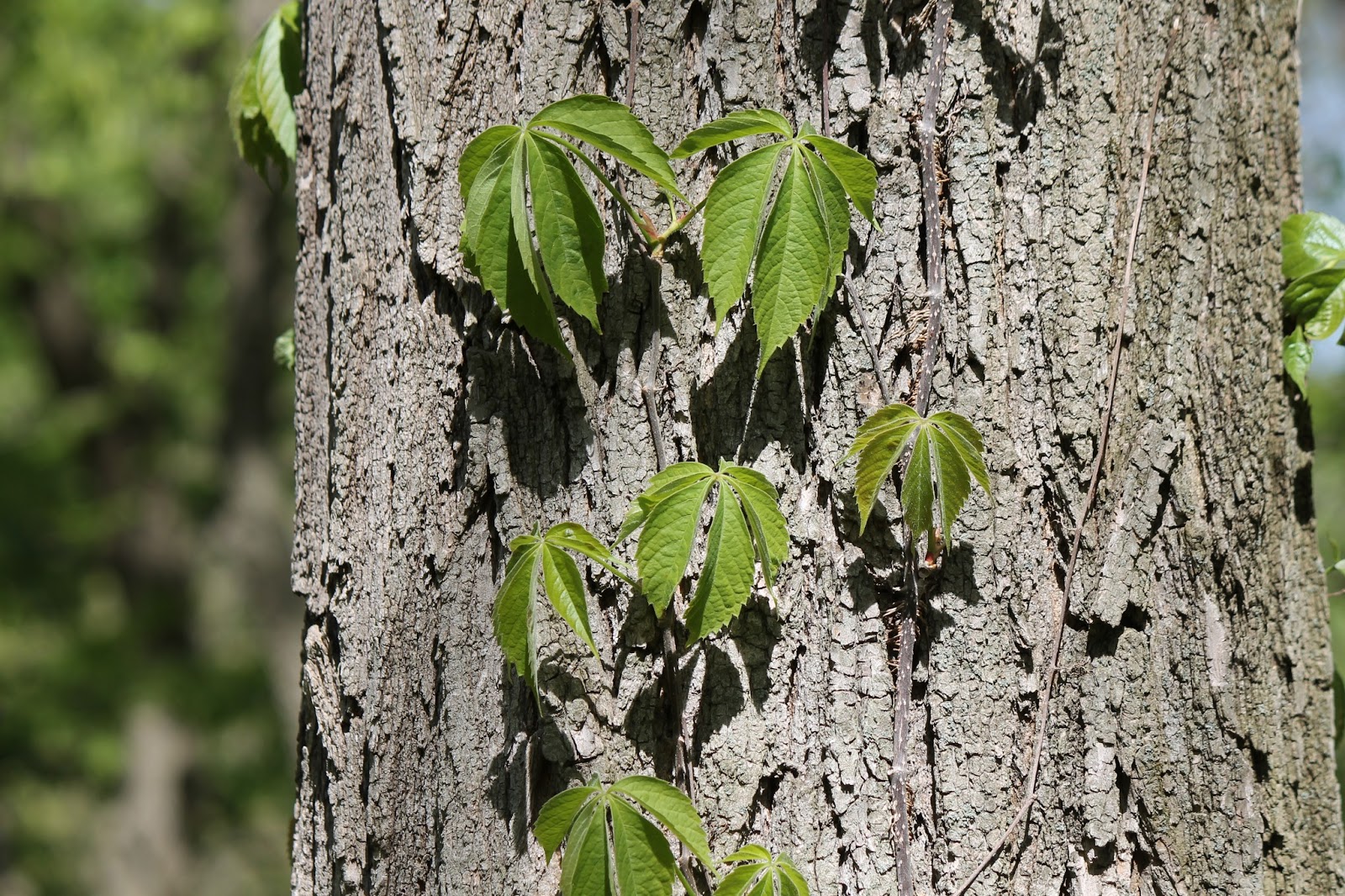
Virginia Creeper

This is Virginia creeper.


People sometimes mistake this plant for poison ivy, but a key difference is that Virginia creeper always has five leaves, and poison ivy only has three.

This plant is native to North America and is most often seen climbing trees.  It can grow along the ground as well.  It turns red in the fall, adding to the beautiful colorscape of the autumn woods and fields.

May 8, 2013

Another New Warbler!

I've discovered another new warbler!

I don't know how I've never noticed this stunning little bird before, but here he is at Smith's Island:


Here's another photo of one over at Fisherman's Corner South:


And one more:


This is a prothonotary warbler.  According to a post over at 10,000 Birds (check it out at the following link: http://10000birds.com/golden-swamp-warbler.htm  ) these birds take their names from early clerks in the Catholic church who wore yellow vestments.  Interestingly, they mention that John James Audubon had called this bird the "golden swamp warbler" but the other name won out.

Protho means "first", and notary means "clerk".

Prothonotary warblers nest in cavities, and can be seen on tree trunks, looking for insects to eat, in a similar manner to nuthatches and creepers.  They live in the Quad City area during the summer months.

If I've missed this brightly-colored beauty all these years, what else is out there that I haven't yet noticed?  Here's to finding more gems out on the trail!

April 29, 2013

River Birch

Here are a couple of photos of river birch bark - such a great tree.  I love the peely look and the colors this tree provides, and it is one of the easier trees to identify.  I always feel like I am seeing an old friend when I come upon one of these.


April 28, 2013

April Mire

Today's post shares a poem by Robert Frost, called "Blue-Butterfly Day."  It is a favorite spring poem of mine, and I am pairing it with a couple of my photos.  Maybe like me, you have noticed that the butterflies are back, zigzagging over the grasses and stopping at all of the early blossoms.


Blue-Butterfly Day
by Robert Frost

It is blue-butterfly day here in spring,
And with these sky-flakes down in flurry on flurry
There is more unmixed color on the wing
Than flowers will show for days unless they hurry.

But these are flowers that fly and all but sing:
And now from having ridden out desire
They lie closed over in the wind and cling
Where wheels have freshly sliced the April mire.


I've always loved that final image - "Where wheels have freshly sliced the April mire."  I've seen the muddy ruts left behind after a vehicle has passed by and how, as the noise of it fades away - the insects and birds return to the new puddles in the altered terrain.

April 26, 2013

Mentha Spicata

Hyperion and I were out walking along the river the other day when he stopped and turned to me.  "I just love that smell," he said.  "It smells like mint."  I could smell it too, and so we looked around to see where it might be coming from.  There at our feet were several beautiful bunches of spearmint.


I plucked a bit of leaf and crushed it between my fingers.  Sure enough - the minty smell burst forth bigger than ever.

I've never found mint growing wild like this, but I have known it was out there.  I just don't know if this mint grew there from an errant seed from someone's garden-variety mint, or if it was a naturally occurring variety.  I've researched the plant a little but haven't been able to come to any conclusions.  

The scientific name is Mentha spicata, and the word mentha originally comes from the Greek minthe.  The term spicata refers to the spikes on the leaves.  

In Greek mythology, Minthe was changed into the plant that now bears her name in order to keep her from improper relations with Hade, god of the underworld.  This connection with the underworld is also evident in the use of mint in ancient burials rights.

April 25, 2013

Tending to Others

Last spring I saw this sight on the water:


At first I thought, "That's a lot of goslings!"  Later I found out that adult Canada geese will often tend the goslings of others in just this way.  In other words, "It takes a village to raise a child."  As you can see, there are at least 24 goslings in this picture, of varying ages and sizes, all learning to paddle and keep an eye out for dangers and look for food.

This reminds me of my friends, Glen and Sylvia.  They routinely looked after others in their lives, and were a dynamic part of whatever community they found themselves in.

Glen and Sylvia both contracted polio in their childhoods, which led to them being wheelchair bound but did not stop them from living useful and exuberant, busy lives.  They met in college and married, taking on the world together, and raising a family of both biological and adopted children.  Glen had a successful engineering business.  Sylvia taught voice and piano.  They drew people to them with their endearing personalities, wit and kindness.  They were always attentive to the one, and their every thought seemed to be focused on what they could do for others.  The number of souls they tended to in their lifetime is untold.

As their health declined in their later years, they had an increasing need for "helpers" in their home.  I had the privilege of being one.  Being in their presence was an education in itself, as I saw them interact so lovingly with one another, and conduct themselves with the highest levels of graciousness and charity.  

Strictly speaking, I worked for Sylvia, but in reality, I was the one being ministered to.  I had the privilege of spending many hours a week with her, incident to her post-polio, but it was she who served and uplifted me with every conversation, and by her sweet example.  In a way, she parented me, and became a beloved friend, mentor, and confidant.

Sylvia passed away recently, and joined her sweetheart, Glen, who passed away several months ago.  I am so glad that I was one of the flock they drew so close to them.  I hope to follow their example and serve others a little better every day.

April 24, 2013

Coots

Up until I started photographing wildlife, I hadn't ever really seen or noticed coots.  I've come to know them as very shy birds who hustle away from me the moment they notice my presence.  Most of my photos show them paddling away for dear life, their wake a widening "V" behind them.  They are friendly with other birds, however, and hang out in mixed flocks.

Now and then I get lucky, and manage to photograph more than just their fleeing forms.

I found this one (below), trying to hide in the reeds at Pigeon Creek.  He had undoubtedly been there as I passed by him on my way up the trail, but an active muskrat and some new birds closer to shore grabbed my attention.  I didn't notice him until my return trip along the path.

When I did finally notice him, he held very still - like a child caught in a cookie jar - and pretended not to see me.


I recently saw my first coot on land.  It wasn't until I had zoomed in on him that I realized what odd feet coots have!  They are "lobed" and massive - not like duck feet at all.  Here is a picture to show you what I mean:

This is a mature coot - not a baby that has yet to "grow into" his feet.

The coot is dark grey with an even darker head.  They have white bills, which make them pretty distinctive.  If you get close to them, you will see that they have a red patch at the base of their bills (on their foreheads), and they have the appearance of red eyes.


Their chicks are beautiful, with orange-tipped feathers.  I would dearly love to get a photo of one!

The word coot comes from the Dutch koet, and in modern times the word has become synonymous with a foolish person.

Here is a pleasant picture to end with, of a social group.  This one was taken by my sister Angie, when she was here visiting.  Thanks, Ang!

Photo by Angie S.

April 17, 2013

A New Bird!

While walking at a river park this week, I noticed lots of little, unfamiliar birds flitting about over the flooded shoreline.  They were too small or were the wrong shape to be the usual lot - robins, cardinals, woodpeckers.  They were fast, and barely rested on any given branch - so it was hard to get a good picture.

In the dim light I couldn't make out any distinguishing marks.  I just knew that they seemed unfamiliar.  The photo below is typical of what I saw.


The bird is below and to the right of center, sitting atop the branch sticking up out of the water - a fuzzy blur.  I took over fifty pictures - trying to get a good, clear shot.

When I got home, I was able to zoom in on the little creatures, and was thrilled to discover that I had photographed a new bird!  Just look at this beauty:


Yellow feathers!  I was amazed.  I didn't know we had any of these around here.  It was a yellow-rumped warbler.  Range maps show that they migrate through this area.  What a find!

The next day, at a different location, I had a similar experience.  There were some little birds in the brush and I couldn't tell what they were for sure, but I had my suspicions.  Here's a typical shot out of about thirty I took that day:


The bird in question is just below and to the right of center.

Imagine my delight when I got home and was able to verify what I had photographed:


This is a male.

Both birds shown here have yellow spots on their crowns, breasts, and rumps.  Both also have a thin, white eyebrow, which distinguishes the Myrtle yellow-rumped warbler from the Audubon's yellow-rumped warbler.

I'm so glad I was able to see these little birds in action as they swooped around the swamp and snapped up numberless midges, and played in the sunny brush near the water.  They will not remain here long as they generally arrive at their northern breeding grounds in late April.

April 9, 2013

The Wily Cormorant

Crafty.  Cunning.  Sly.

Always diving under the water when I get anywhere within sight of him.

And yet, at last, I managed to get some decent photos of him - the wily cormorant.

Mad-Scientist Look

Note how low in the water his body is...

April 8, 2013

Bathing Beauties

Caught up with these bathing beauties this weekend at Smith's Island.  There was a whole lot of preening going on!

April 4, 2013

Finally!

Finally - I got a hawk!

This sharp-eyed fellow
 was sitting way up in my neighbor's tree in the back yard, and I was lucky enough to get a couple of shots of it.


For me, hawks are very difficult to photograph.  If I get anywhere near them, whether in my car or on foot, they fly away before I can get the lens cap off.  When I saw this one out the back window, I got my camera ready and crept into the garage.  I opened the back door very quietly and stood inside the garage to get the first picture.

I ventured a few steps into the yard and his head snapped toward me instantly.  Even over the long distance between us, I felt a tingle and realized I'd been spotted by a predator.  Good thing I'm too big to be his lunch!


He quickly up and flew away, wanting nothing to do with me.  After some preliminary research, I believe this is a Red-tailed hawk.  This is a wonderful first for me, after over a year of hunting.

April 3, 2013

American Hogpeanut

This is just the plant you wanted to learn about today.  You will soon be seeing it again, growing all over the forest floor and twining itself around anything that can give it support.

Up until now, I have been mistaking this plant for a common violet!  It is actually an amazing entity.  It produces two different flowers, and two different seeds.

If you take a moment to look at the leaflets in this photo, you will probably be able to identify this plant when you see it again in the wild.


Each compound leaf has three leaflets with sharp tips and asymmetrical bases.  You can see a kind of bulge on the base of the leaflets in the photo above.  And the middle leaflet of the three is larger, with a longer stem.

This plant's name is a perfect example of how so much scientific information can be packed into a couple of words.  Quoting from gobotany.newenglandwild.org we learn the following:

"The genus name is from the Greek amphi (of both kinds) and carpos (fruit) and refers to the two kinds of fruit.  The seeds of the upper fruit are inedible, but those from the underground fruit are edible when boiled.  Birds feed on the seeds of both kinds of fruit.  Hogs eat the seeds of the fruit below ground, hence the plants (sic) common name."

Many thanks to my friend Bryan R. (from Wood Badge), who helped me successfully identify this plant when it was driving me crazy by being so familiar and yet so anonymous!