
September 13, 2014
Hybrid Mallard
Does this mallard look a little different to you? His mottled breast leads me to believe that it is - a cross between two similar kinds of waterfowl.

September 11, 2014
Green Leaf Bug
The wings on this bug look just like a green leaf, with veins and all:

It's a katydid!
It's hard for me to believe that I could reach this ripe old age without ever having seen a katydid before. but it's true. I just found this one last month. It was on a window screen or I never would have noticed it - so perfect is its camouflage.
There are several kinds of katydids in North America, and even though I've never seen one until now, I've heard them all the days of my life. It is the sound of summer.
Take a listen on NaturesFairy's YouTube video, found here:
https://www.youtube.com/watch?v=ob2rEjRz-RM
Anyone interested in learning more katydis them should check out this wonderful website called "Valerie's Austin Bug Collection". It has many fabulous photos of the different kinds, showing their various features such as wing shape:
http://www.austinbug.com/tettigoniidae.html

The ovipositor on this one lets us know it is a female.
It's a katydid!
It's hard for me to believe that I could reach this ripe old age without ever having seen a katydid before. but it's true. I just found this one last month. It was on a window screen or I never would have noticed it - so perfect is its camouflage.
There are several kinds of katydids in North America, and even though I've never seen one until now, I've heard them all the days of my life. It is the sound of summer.
Take a listen on NaturesFairy's YouTube video, found here:
https://www.youtube.com/watch?v=ob2rEjRz-RM
Anyone interested in learning more katydis them should check out this wonderful website called "Valerie's Austin Bug Collection". It has many fabulous photos of the different kinds, showing their various features such as wing shape:
http://www.austinbug.com/tettigoniidae.html
The ovipositor on this one lets us know it is a female.
Chipping Sparrow
I sometimes despair of ever being able to identify all the different kinds of sparrows, but at least I have figured one out - the chipping sparrow!
They have chestnut crowns, and black eye streaks, and are very common in the midwest.

This one was busy gathering materials, probably to reinforce the traditionally flimsy nest that most chipping sparrows build.
They build low to the ground and have a penchant for using hair in their nests.

They have chestnut crowns, and black eye streaks, and are very common in the midwest.
This one was busy gathering materials, probably to reinforce the traditionally flimsy nest that most chipping sparrows build.
They build low to the ground and have a penchant for using hair in their nests.
September 9, 2014
Thinleaf Sunflower
Have you ever heard of thinleaf sunflowers? I had never heard of them, until today. However, I've SEEN them dozens of times.
Here's a picture:

See the thinner, sharply pointed leaves?
These sunflowers are also called "ten-petal sunflowers", although they can actually have 8 - 12 petals. They are woodland flowers, and I found these in western Illinois.

Butterflies seek out this plant to lay their eggs, and muskrats favor this plant as well.
The species name is Helianthus decapetalus. Isn't that perfect? Helianthus comes from Helios, god of the sun (that equates with Hyperion of Green mythology), and decapetalus represents the ten petals.
Here's a picture:
See the thinner, sharply pointed leaves?
These sunflowers are also called "ten-petal sunflowers", although they can actually have 8 - 12 petals. They are woodland flowers, and I found these in western Illinois.
Butterflies seek out this plant to lay their eggs, and muskrats favor this plant as well.
The species name is Helianthus decapetalus. Isn't that perfect? Helianthus comes from Helios, god of the sun (that equates with Hyperion of Green mythology), and decapetalus represents the ten petals.
September 8, 2014
Jewel Weed Blossoms
These are spotted jewelweed blossoms.

They have a trumpet shape and rich coloring, making them most intriguing!

These blossoms are little beauties, but I also liked the way the droplets of rain formed beads upon the leaves.
Below is the yellow form of jewelweed, which is a little more rare.

You are most likely to find jewelweed along creeks and streams. They like to keep their roots wet. They are also often found in the same neighborhood as stinging nettle. Jewelweed is said to be a good antidote for the sting of the nettle, and for poison ivy and insect bites. But if all else fails, they are still simply beautiful to look at.
They have a trumpet shape and rich coloring, making them most intriguing!
These blossoms are little beauties, but I also liked the way the droplets of rain formed beads upon the leaves.
Below is the yellow form of jewelweed, which is a little more rare.
You are most likely to find jewelweed along creeks and streams. They like to keep their roots wet. They are also often found in the same neighborhood as stinging nettle. Jewelweed is said to be a good antidote for the sting of the nettle, and for poison ivy and insect bites. But if all else fails, they are still simply beautiful to look at.
Virgin Tiger Moth

This is the Virgin Tiger Moth. I was struck by its beautiful pattern, which reminded me of stained glass windows.
I wish I had known enough to spread this one's wings to see the beautiful red under-wings that I read about later! They range from yellow to orange to red with black spots - hence the "tiger" in the name.
This one had been caught in a spider web and so was not in the best of shape when photographed, poor thing!
May 31, 2014
Wood Ducks
Someday I will get a better shot of a wood duck, but for now I'll take what I can get.
Hyperion and I were hiking in a rarely visited area of an island in the Mississippi when I photographed a passing pair of wood ducks.
.JPG)
They were far away and obscured by trees, but with the magic of digital zoom, we can see enough markings to know what we are looking at.

Wood ducks are beautiful little ducks, and the males are iconic for their brightly colored plumage, with green and purple on their heads and white stripes. They have red eyes, with red and yellow on their bills.
Wood ducks have shorter wings than other ducks, which help them fly though woodlands, where they nest in tree cavities, and in wood duck boxes. Their claws (rare in ducks) help them grip the bark where they perch.

They prefer shallow, marshy waters and ponds, where they can feed easily. Besides aquatic food sources, they also eat acorns.
Wood ducks float higher on the water than other ducks, so that is something to remember when trying to identify them at a distance.
Something unique about wood ducks is that they are the only North American duck to have two broods per season.
Wood ducks are also called summer ducks and Carolina ducks.
Hyperion and I were hiking in a rarely visited area of an island in the Mississippi when I photographed a passing pair of wood ducks.
They were far away and obscured by trees, but with the magic of digital zoom, we can see enough markings to know what we are looking at.
Wood ducks are beautiful little ducks, and the males are iconic for their brightly colored plumage, with green and purple on their heads and white stripes. They have red eyes, with red and yellow on their bills.
Wood ducks have shorter wings than other ducks, which help them fly though woodlands, where they nest in tree cavities, and in wood duck boxes. Their claws (rare in ducks) help them grip the bark where they perch.
They prefer shallow, marshy waters and ponds, where they can feed easily. Besides aquatic food sources, they also eat acorns.
Wood ducks float higher on the water than other ducks, so that is something to remember when trying to identify them at a distance.
Something unique about wood ducks is that they are the only North American duck to have two broods per season.
Wood ducks are also called summer ducks and Carolina ducks.
May 29, 2014
Blog Contest Prizes
For my 250th post, I held a contest here on the blog. That was back in February. There were 10 multiple choice questions, and one bonus question.
You can see the quiz here: http://foundonthetrail.blogspot.com/2014/02/250th-post-celebration-contest.html .)
We had wonderful participation, more than doubling the number of participants from my first contest at the 100 blog post point. We went from 3 participants to 8! Huzzah!
It was a wonderful chance for me to see what the contest winners would pick for their prizes, and to see how the nature photos posted here look in different formats. All the top scores were put in a hat and the winners were picked randomly for fabulous prizes!
2nd place won the photo magnets prize. This went to my friend Ashley, who is herself a nature guru. Here are the magnet photos she picked out, now gracing her filing cabinet at work. Pelicans, the Jack O'Lantern mushrooms, a bumble bee, and a dragonfly:
It should be no surprise that among her top choices for photo magnets, one was the lovely and mysterious Jack O'Lantern mushroom, as Ashley is the maven of mushroom identification. Here's the original blogpost on those fungi: http://foundonthetrail.blogspot.com/2012/08/night-adventures.html .
Ashley has her own nature blog, which you might want to check out. It's on the sidebar in my blogroll. It's called "Amore Feral Natura". Here's a link: http://amorferalnatura.blogspot.com/2014/03/mystery-mushroom.html . Happy reading, and happy viewing!
1st place - a canvas print - went to my friend Coleen, who has been a walking and photography companion of mine. For her canvas she selected a winter scene with a couple of dozen eagles perched in a tree:

I wish you all could have won prizes! It was so much fun holding this contest that I want to hold another one soon, so I'd better get to writing in order to hit the next big number!
You can see the quiz here: http://foundonthetrail.blogspot.com/2014/02/250th-post-celebration-contest.html .)
We had wonderful participation, more than doubling the number of participants from my first contest at the 100 blog post point. We went from 3 participants to 8! Huzzah!
It was a wonderful chance for me to see what the contest winners would pick for their prizes, and to see how the nature photos posted here look in different formats. All the top scores were put in a hat and the winners were picked randomly for fabulous prizes!
2nd place won the photo magnets prize. This went to my friend Ashley, who is herself a nature guru. Here are the magnet photos she picked out, now gracing her filing cabinet at work. Pelicans, the Jack O'Lantern mushrooms, a bumble bee, and a dragonfly:
 |
| Photo courtesy of Ashley - thanks, Ashley! |
Ashley has her own nature blog, which you might want to check out. It's on the sidebar in my blogroll. It's called "Amore Feral Natura". Here's a link: http://amorferalnatura.blogspot.com/2014/03/mystery-mushroom.html . Happy reading, and happy viewing!
1st place - a canvas print - went to my friend Coleen, who has been a walking and photography companion of mine. For her canvas she selected a winter scene with a couple of dozen eagles perched in a tree:
I wish you all could have won prizes! It was so much fun holding this contest that I want to hold another one soon, so I'd better get to writing in order to hit the next big number!
May 27, 2014
Snakes Alive!
In all my walks and all my wanderings, since I took up photographing animals and plants, I have never seen a snake on my own. And then yesterday - I saw two!
The first snake was swimming through the flood waters at Pigeon Creek Park, over, around and under the mass of floating debris. It was his movement that attracted my attention, with his head just sticking out of the water and his long, narrow body trailing behind. He pulled up on a log and rested part of his body but kept a wary eye on me:

The second snake was at Eagle's Landing, where there weren't many trees to provide shade. As a result, you can see more of the pattern this second snake was sporting, unlike the first.


I'm not an expert on snakes, and have only done a little research on these. There's not much to go on. My best guess, based on the markings, is that both snakes were the fairly common Northern Water Snake. They cruise along shorelines and in backwaters eating as they go - fish, crawfish, baby turtles and even worms.
Northern Water Snakes are vicious, and are known to strike at and bite people repeatedly when disturbed or cornered - so keep your distance! They are not venomous, so washing the bites is the only treatment needed, but ouch! Snakes are not my favorite critters, but still - they do play a role in a healthy ecosystem.
The first snake was swimming through the flood waters at Pigeon Creek Park, over, around and under the mass of floating debris. It was his movement that attracted my attention, with his head just sticking out of the water and his long, narrow body trailing behind. He pulled up on a log and rested part of his body but kept a wary eye on me:
The second snake was at Eagle's Landing, where there weren't many trees to provide shade. As a result, you can see more of the pattern this second snake was sporting, unlike the first.
I'm not an expert on snakes, and have only done a little research on these. There's not much to go on. My best guess, based on the markings, is that both snakes were the fairly common Northern Water Snake. They cruise along shorelines and in backwaters eating as they go - fish, crawfish, baby turtles and even worms.
Northern Water Snakes are vicious, and are known to strike at and bite people repeatedly when disturbed or cornered - so keep your distance! They are not venomous, so washing the bites is the only treatment needed, but ouch! Snakes are not my favorite critters, but still - they do play a role in a healthy ecosystem.
Chipmunk!
Finally got my first good clear pictures of a chipmunk at Crow Creek park last month. They are speedy little critters and always dart out of sight whenever I get a glimpse of them. This one, however, was brave enough, or curious enough to check me out for a few minutes. Never would have got these without my zoom lens!


This is an Eastern chipmunk. The name comes from the Ojibwa word "achitamon", which means "descending head first". Isn't that cool?!!!
As you probably know, chipmunks store food in their cheeks in order to carry it to a supply depot. That's why this little lady's cheeks are puffed out so fat!
This post is for my friend, Sarah, who has a particular penchant for some members of the rodentia family. Hope you liked this cute little critter!
This is an Eastern chipmunk. The name comes from the Ojibwa word "achitamon", which means "descending head first". Isn't that cool?!!!
As you probably know, chipmunks store food in their cheeks in order to carry it to a supply depot. That's why this little lady's cheeks are puffed out so fat!
This post is for my friend, Sarah, who has a particular penchant for some members of the rodentia family. Hope you liked this cute little critter!
May 25, 2014
Turtles Galore
A walk along a quiet lake shore turned up turtles galore:

There are over 30 turtles in this photo, big and small, basking in the spring sunshine!
Here are some close-ups:

.JPG)
.JPG)
This is either a turtle convention - possibly met to plot the destruction of human-kind, or there is a whole lot of poikilothermism going on. What's that, you say? Yes, poikilothermism, which means the state of being cold-blooded. Now, did they have murderous intent, or were they simply sunbathing in order to warm themselves up a little? We may never know.
What we do know, however, is that "poikilos" comes from the Greek and meshes with "thermal" to indicate these kinds of creatures (fish and reptiles) that cannon maintain their own body temperature the way mammals can.
There are over 30 turtles in this photo, big and small, basking in the spring sunshine!
Here are some close-ups:
This is either a turtle convention - possibly met to plot the destruction of human-kind, or there is a whole lot of poikilothermism going on. What's that, you say? Yes, poikilothermism, which means the state of being cold-blooded. Now, did they have murderous intent, or were they simply sunbathing in order to warm themselves up a little? We may never know.
What we do know, however, is that "poikilos" comes from the Greek and meshes with "thermal" to indicate these kinds of creatures (fish and reptiles) that cannon maintain their own body temperature the way mammals can.
May 23, 2014
Spring Sunset
We met at the park recently, with our scout troop, and the spring sunset was absolutely gorgeous!
The colors changed so rapidly. Here are 3 shots:
The colors changed so rapidly. Here are 3 shots:
 |
| 8:17 p.m. |
 |
| 8:30 p.m. |
 |
| 8:33 p.m. |
May 20, 2014


May 19, 2014
A Loon
I was taking my usual walk and saw two pelicans across the LeClaire channel from Smith's Island. They were pretty far away, and I knew photos of them wouldn't do justice to their beauty. Still, there was something in me - there always is, that wants to photograph every animal I see. As I stood on the shore and watched them, I noticed something else moving in the water near them. It was so low in the water and so far away that I could not tell what it was.
I knew it was not a Canada goose, because it was not big enough, and it wasn't brown. I put the camera up to my eye and zoomed in as far as I could on it. I could see that it was grey, and had a long bill, but everything else was pretty indistinct.

Because the mind wants to match what you see with what you are already familiar with, the thought crossed my mind that maybe this was a heron, down in the water, floating. I've never seen a heron do that before. I don't even know if they would be able to fold up their long legs and do that. But that is all I could come up with on the first pass. At the same time, I knew it was not a heron. Too many things didn't seem fit. But what was it?
I snapped a several pictures, even as the bird seemed to appear and disappear. I was so far away I couldn't tell if it was diving and reappearing, or if it was just so well camouflaged that it seemed to disappear against the opposite bank.
I knew it was something I was completely unfamiliar with, and that was exciting. A new bird!
Thanks to the power of the editing capabilities of Photo Gallery, I was able to zoom in on this bird on my computer at home, and get my first up close look at it.

The first thought that came into my head was, "It looks like a loon." How that could be, I didn't know, but that is the power of field guides.
I had never seen a loon in the real life before - never expected to see one. They just don't live around here. But I have looked at dozens of field guides over the years. I've done more than look. I've poured over them, examining the picture carefully, absorbing details about beaks, body shape, color patterns, and postures. I've read the descriptions relating typical behavior for the various species. And somehow, as this bird came into focus, I just knew it was a loon.
It didn't look like a loon - not the gorgeous black and white kind you see in slick magazines about the north woods, but that's where I learned something new. The classic picture of a loon with it's black and white checkered back and red eyes show a loon in its mating plumage - stunningly beautiful. This one, in our humble little LeClaire channel, was wearing it's non-breeding feathers, and so looked very plain. It was just passing through, migrating back to it's home in the north. I'm so glad I got to see it, and photograph it, and learn a little bit more about loons. This is a real first in my book!
 |
| The bird in question is 4 pelican body-lengths to the left of the left pelican, against the shore. |
Because the mind wants to match what you see with what you are already familiar with, the thought crossed my mind that maybe this was a heron, down in the water, floating. I've never seen a heron do that before. I don't even know if they would be able to fold up their long legs and do that. But that is all I could come up with on the first pass. At the same time, I knew it was not a heron. Too many things didn't seem fit. But what was it?
I snapped a several pictures, even as the bird seemed to appear and disappear. I was so far away I couldn't tell if it was diving and reappearing, or if it was just so well camouflaged that it seemed to disappear against the opposite bank.
I knew it was something I was completely unfamiliar with, and that was exciting. A new bird!
Thanks to the power of the editing capabilities of Photo Gallery, I was able to zoom in on this bird on my computer at home, and get my first up close look at it.
The first thought that came into my head was, "It looks like a loon." How that could be, I didn't know, but that is the power of field guides.
I had never seen a loon in the real life before - never expected to see one. They just don't live around here. But I have looked at dozens of field guides over the years. I've done more than look. I've poured over them, examining the picture carefully, absorbing details about beaks, body shape, color patterns, and postures. I've read the descriptions relating typical behavior for the various species. And somehow, as this bird came into focus, I just knew it was a loon.
It didn't look like a loon - not the gorgeous black and white kind you see in slick magazines about the north woods, but that's where I learned something new. The classic picture of a loon with it's black and white checkered back and red eyes show a loon in its mating plumage - stunningly beautiful. This one, in our humble little LeClaire channel, was wearing it's non-breeding feathers, and so looked very plain. It was just passing through, migrating back to it's home in the north. I'm so glad I got to see it, and photograph it, and learn a little bit more about loons. This is a real first in my book!
May 13, 2014
Lily of the Valley
Lily of the Valley is a charming little plant with tiny white flowers that look as if they were little bells that could be rung. It has a most delightful scent, and seems to be a fairly beloved plant. It is native to North America, but is also grown domestically.
I came across a large colony of them on one of my walks:

Despite it's sweet fragrance and beauty, this plant is highly poisonous.
Other names for this plant include Our Lady's Tears and Mary's Tears stemming from a legend that they sprouted from tears shed by Mary, the mother of Jesus, at the crucifixion. Another legend references the tears shed by Eve after being cast out of the Garden of Eden.
I came across a large colony of them on one of my walks:
Despite it's sweet fragrance and beauty, this plant is highly poisonous.
Other names for this plant include Our Lady's Tears and Mary's Tears stemming from a legend that they sprouted from tears shed by Mary, the mother of Jesus, at the crucifixion. Another legend references the tears shed by Eve after being cast out of the Garden of Eden.
May 10, 2014
Pterodactylish
Pelicans in the air are a totally different bird than pelicans floating placidly on the water. In flight, you see the black underside of their wings, which are normally wrapped sedately about them when not in flight.

They are massive birds, and you get a real sense of their size when they fly by with their 9 foot wingspan. And then there is something prehistoric in their shape and motion. On the water, they look almost like swans. In the air, they look like pterodactyls!
They are massive birds, and you get a real sense of their size when they fly by with their 9 foot wingspan. And then there is something prehistoric in their shape and motion. On the water, they look almost like swans. In the air, they look like pterodactyls!
May 8, 2014
Pardon Me!
I interrupted this squirrel in the middle of his fine repast of organic walnuts.
He stopped and gave me such a look as if to say, "How gauche!" Then he proceeded to pretend not to see me.
He could not believe my effrontery in stepping closer and closer to him!

In my turn, I pretended not to see the crumbs still lingering in his whiskers, and I went my way.
He stopped and gave me such a look as if to say, "How gauche!" Then he proceeded to pretend not to see me.
He could not believe my effrontery in stepping closer and closer to him!
In my turn, I pretended not to see the crumbs still lingering in his whiskers, and I went my way.
April 28, 2014
The Promise of Spring
They're back!
All of the spring wildflowers are returning. Actually, they never really went anywhere. Since their last blooming, the roots have been biding their time safely underground, waiting for the time to be right to send forth their tender shoots again.
Here are two kinds:
I've walked the trails a dozen times since the last wildflowers bloomed here, and I've thought happily of these little plants resting in their dormant state under the earth and snow. I knew they would spring forth again. It's like having a secret to gladden the heart, even while you walk amidst the bare trees of deepest winter.
I can't help comparing this natural phenomenon to the death and resurrection of Jesus Christ. He died for us, and was buried in the tomb, but rose again three days later. He conquered death. I am so thankful for Him! He is the Savior of the world, and our hope in an eternal life. Even while we walk our daily path here on the earth - in sometimes barren surroundings (barren of love, of kindness, understanding, health - you name it) - we can know that "spring" will come for us. I know that Jesus Christ died for us, and that He lives now, that He loves us, and that He will come again in the fullness of time! I look forward to that joyous day!
All of the spring wildflowers are returning. Actually, they never really went anywhere. Since their last blooming, the roots have been biding their time safely underground, waiting for the time to be right to send forth their tender shoots again.
Here are two kinds:
 |
| Dutchman's Breeches (it's just fun to say!) |
 |
| Spring Beauties |
I can't help comparing this natural phenomenon to the death and resurrection of Jesus Christ. He died for us, and was buried in the tomb, but rose again three days later. He conquered death. I am so thankful for Him! He is the Savior of the world, and our hope in an eternal life. Even while we walk our daily path here on the earth - in sometimes barren surroundings (barren of love, of kindness, understanding, health - you name it) - we can know that "spring" will come for us. I know that Jesus Christ died for us, and that He lives now, that He loves us, and that He will come again in the fullness of time! I look forward to that joyous day!
Skull Found
There is something new to see in the woods every day, and this time around it was an animal skull.
I found it on an island in the Mississippi, right at the farthest point of a loop trail I walk frequently.
I was surprised to see it there and did all of the usual wondering - what is it? How did it get here? Where's the rest of it?
After examining the object, and noting it's teeth, I thought it must be an herbivore of some kind, but the long "snout" made me wonder a little. (I'm just not used to identifying animals by their skulls. I've never seen that many in my life!)
Here's a top view:

And here it is, in situ, as they say, with my sandal next to it for a frame of reference of its size. Note the rather large eye sockets:

What would your guess be?
This little mystery was solved when I showed the photos to Hyperion. "Fawn skull," he said, with little hesitation. Does this many know everything?!!!
We've seen deer prints on the island before, and I know they can swim the LeClaire channel or the river on the other side, to get to the island. But what caused the death of this fawn, and how did the skull get carried to this point? I have seen the remains of rabbit kills near this same place a couple of times before, and have assumed that a large owl was responsible for that debris. I may never know all the details of this story.
I found it on an island in the Mississippi, right at the farthest point of a loop trail I walk frequently.
I was surprised to see it there and did all of the usual wondering - what is it? How did it get here? Where's the rest of it?
After examining the object, and noting it's teeth, I thought it must be an herbivore of some kind, but the long "snout" made me wonder a little. (I'm just not used to identifying animals by their skulls. I've never seen that many in my life!)
Here's a top view:
And here it is, in situ, as they say, with my sandal next to it for a frame of reference of its size. Note the rather large eye sockets:
What would your guess be?
This little mystery was solved when I showed the photos to Hyperion. "Fawn skull," he said, with little hesitation. Does this many know everything?!!!
We've seen deer prints on the island before, and I know they can swim the LeClaire channel or the river on the other side, to get to the island. But what caused the death of this fawn, and how did the skull get carried to this point? I have seen the remains of rabbit kills near this same place a couple of times before, and have assumed that a large owl was responsible for that debris. I may never know all the details of this story.
April 25, 2014

April 23, 2014
Muskrat Again
I saw another muskrat in the same place as last year!
The Mississippi is flooding and the waters have reached a walkway in one of my favorite parks. This allows the muskrats to swim very close to the path, and has serendipitously created an opportunity - two years in a row - for me to photograph muskrats!
Last year I just saw one swimming frantically back and forth. This year, the muskrat I saw was swimming in a more leisurely fashion. He even took time to climb onto a log, so I was able to get a full body shot instead of just two little pointy ears with two eyes and a snout poking out of the water.

While diving under the surface he found a plant he liked and came up smiling with it. He proceeded to eat it up as he sat on the log, and later as he wallowed in the water up to his elbows.
The Mississippi is flooding and the waters have reached a walkway in one of my favorite parks. This allows the muskrats to swim very close to the path, and has serendipitously created an opportunity - two years in a row - for me to photograph muskrats!
Last year I just saw one swimming frantically back and forth. This year, the muskrat I saw was swimming in a more leisurely fashion. He even took time to climb onto a log, so I was able to get a full body shot instead of just two little pointy ears with two eyes and a snout poking out of the water.
While diving under the surface he found a plant he liked and came up smiling with it. He proceeded to eat it up as he sat on the log, and later as he wallowed in the water up to his elbows.
April 22, 2014
Watcher in the Woods
Every morning I find myself passing through a wooded area. I've gotten used to the little landmarks there, including a downed tree with a deep hole in the trunk. It makes a big black spot in the woods, which always draws my attention.
Today, there was something different. Above the hole in the downed trunk there was a big white blob. That's what it looked like to me, anyway. I thought to myself, "Hmmm. I don't remember that a big white blob being there before."
I asked Jason, who was with me at the time. He has better eyes than me. I said, "Hey, is that an animal on that log in the woods there?" He took a cursory glance but wasn't really interested in my little mystery. I grabbed my camera so I could use my zoom lens to get a good look.
Sure enough, it was a big cat. Not a bobcat, just a domestic cat that might or might not be feral. Still, in was an unexpected capture with my camera and I was pleased to have noticed it. Here it is:

So the next time you take a walk in the woods and you get that creepy feeling that someone - or something - is watching you, you just might be right!
Today, there was something different. Above the hole in the downed trunk there was a big white blob. That's what it looked like to me, anyway. I thought to myself, "Hmmm. I don't remember that a big white blob being there before."
I asked Jason, who was with me at the time. He has better eyes than me. I said, "Hey, is that an animal on that log in the woods there?" He took a cursory glance but wasn't really interested in my little mystery. I grabbed my camera so I could use my zoom lens to get a good look.
Sure enough, it was a big cat. Not a bobcat, just a domestic cat that might or might not be feral. Still, in was an unexpected capture with my camera and I was pleased to have noticed it. Here it is:
So the next time you take a walk in the woods and you get that creepy feeling that someone - or something - is watching you, you just might be right!
March 27, 2014
Big Gulp!
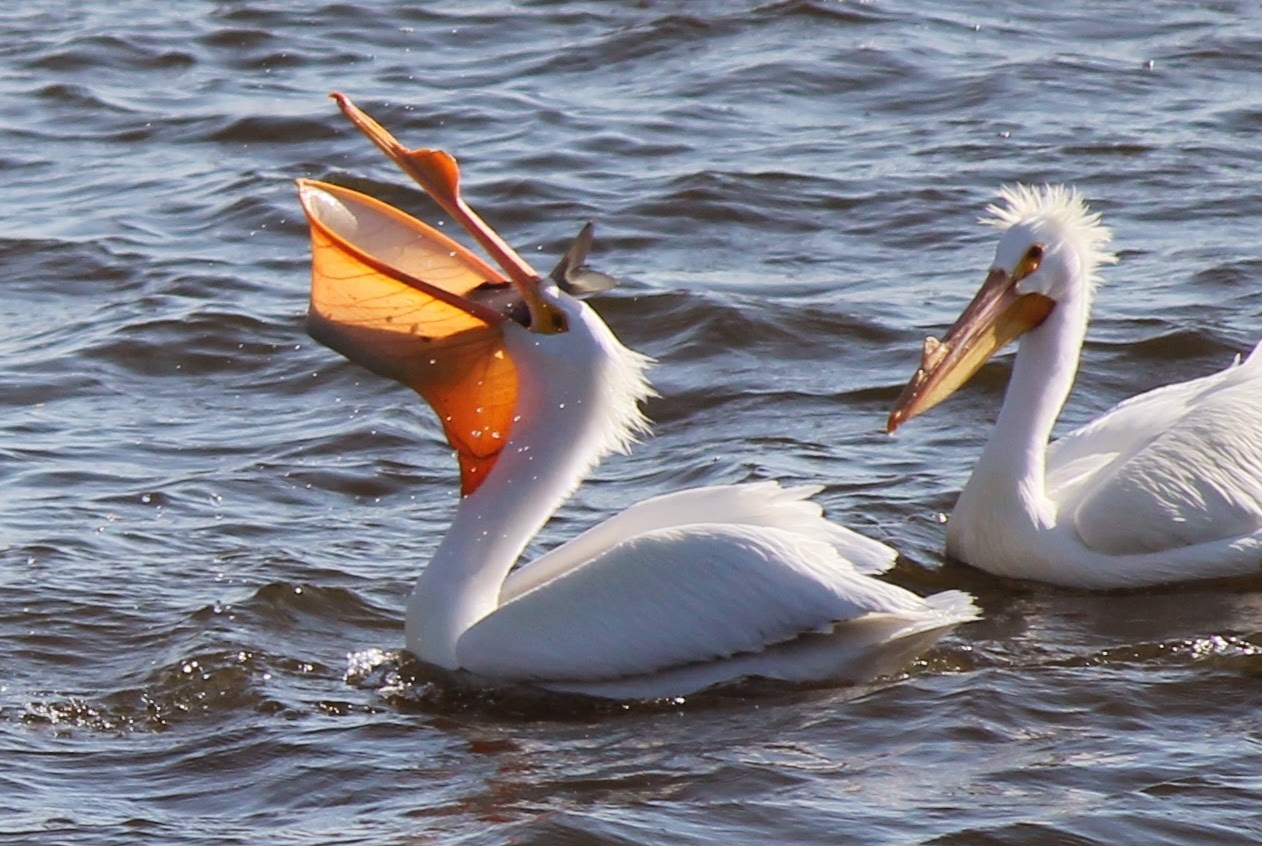
I had fun photographing pelicans the other day. This one was trying to swallow a fish:

You can see the fish clearly in the first picture, above.
In the next picture, you can see the fish's tail fins sticking out of the pelican's bill. The rest of the fish can be seen in silhouette through the opaque bill. (Notice the refraction!)

The pelican began tipping its head back in an effort to swallow it. Look at the amazing detail of the blood vessels in the bill!

As he tips his head back a little further, you can still see the fish silhouetted in the bottom of the pelican's bill. You can even see the fish's tail fins!
I wonder how the pelicans avoid having the flexible material of their bills torn by the sharp fins of the fish they eat?

The pelican tried to get the fish headed down its gullet, but it took three or four tries of trying to throw it back down its throat before he managed it. It was quite the display.
You can see the fish clearly in the first picture, above.
In the next picture, you can see the fish's tail fins sticking out of the pelican's bill. The rest of the fish can be seen in silhouette through the opaque bill. (Notice the refraction!)
The pelican began tipping its head back in an effort to swallow it. Look at the amazing detail of the blood vessels in the bill!
As he tips his head back a little further, you can still see the fish silhouetted in the bottom of the pelican's bill. You can even see the fish's tail fins!
I wonder how the pelicans avoid having the flexible material of their bills torn by the sharp fins of the fish they eat?
The pelican tried to get the fish headed down its gullet, but it took three or four tries of trying to throw it back down its throat before he managed it. It was quite the display.
Subscribe to:
Posts (Atom)