September 23, 2013

Downy Gentians

Look at these beauties!


I found these lovely flowers while walking out at Scott County Park last Saturday, on the Glynn's Creek Trail.    The trail is mostly through woods, but one glorious stretch takes you past a tall grass prairie, and there they were.


Their lovely purple blossoms caught my eye immediately.  They were tucked away everywhere in the tall grasses, and I went from blossom to blossom like a kid in a candy store, delighting over each one.  They were so pretty!


I particularly loved over the whorled, two-tone petals on the not-yet-fully-opened blossoms.


These downy gentians (so-called due to the tiny hairs on their stems) are sometimes called prairie gentians.  They are among the last flowers to bloom in the late summer, but as I think anyone would agree, they are well worth the wait!


The white and green stripes inside the blossoms helped me identify them. although it was hard to get a look inside as the bees were very busy collecting their pollen!

The name "gentian" comes the name of the ancient Ilyrian king, Gentius, who ruled beginning in 181 BC.  He was said to have used this plant to treat a sickness among his people.

September 19, 2013

Mudflat Friends

Ok, this wasn't really a mudflat, since those are formed by tides on coastal wetlands, but that is the word that came to mind when I saw these shorebirds out at Nahant Marsh.

Notice the difference in beak length between these two birds.

The bird in the foreground is a killdeer, and the one in back is a sandpiper.  They were out in the mud exposed by the low water level in the marsh, searching for food.


I have found both of these birds to be extremely difficult to photograph.  They are leery of people, and fly away before I can usually get within a good shooting range.  It was fun to catch the two of them together like this in one photo, and have each one show up pretty clearly.

September 18, 2013

Wild Turkey

This is a wild a turkey.  I am posting this photo today so that it will be back to back with my post from yesterday on the turkey vulture.  They both have bald heads and so share a name element.


Wild turkeys can be much more majestic than this, especially when the toms spread their tail feathers into big, beautiful fans and strut around in front of the hens.  One day I hope to photograph such a sight!

I took this photo along State Street, between Scott Community College and Crissey House - the oldest residence still standing in Riverdale, Iowa.  There is often a small flock of wild turkeys foraging there, in spite of the daily stream of noisy traffic along Highway 67.  This is unique, since wild turkeys are normally very skittish.  If I see them at all on my nature walks, they are usually hustling into the cover of tall grass or underbrush.

Has anyone else in the local area seen this particular flock?

September 17, 2013

Turkey Vultures

Turkey vultures are hawk-like birds who ride thermal waves in the sky, often in small groups.  They have darker underbellies than hawks, and have a more wobbly flight.


Turkey vultures have a bald head that is dark pink or red in appearance, with a white-tipped beak.  The appearance of their head, being similar to that of a wild turkey, gives them their common name.

While sometimes called buzzards or carrion crows, these are misnomers.  Their scientific name is quite grand:  Cathartes aura.  Loosely translated, this means "purifying bird".  This is related to the fact that they eat carrion, which otherwise would stink up the world in a big way.

This one was spotted above Nahant Marsh, soaring around in a circle.  Evidently something already dead had caught its eye - or rather its nose, for that is how turkey vultures most often identify their next meal.

September 16, 2013

Hummingbird Moth

When you see a new critter two or three times in a week, it's time to look it up!  That's what happened to me this week, with the hummingbird moth.

Have you ever seen one?  They look a lot like hummingbirds in size, shape, and behavior, and yet they are moths.

It's hard to distinguish what they are when you see them because they hover around blossoms in a manner similar to hummingbirds, with their wings beating so fast they are a blur.  Their motion in flight, however, is slightly more fluttery and less darty than an actual hummingbird - if you know what I mean.

I finally had my camera with me when I saw this one on Saturday.


This is a white-lined sphinx moth, and it is one of the hummingbird moths.

It has six legs, one pair of antennae, and an incredibly long proboscis for sipping nectar.  In fact, it sometimes exceeds ten inches!


So, the next time you think you see a hummingbird, double-check and see if it might be one of these unique creatures instead.

September 10, 2013

House Sparrow

House Sparrows.  Yep, they're an invasive species, but still interesting.

Fun Fact #1:  According to allaboutbirds.com, house sparrows were first introduced to the United States in 1851, in Brooklyn, New York.  Click here to read about that:   http://www.allaboutbirds.org/guide/house_sparrow/lifehistory .

Fun Fact #2:  The larger the black patch on a male house sparrow's throat, the more dominant he is in the pecking order of the flock.


Fun Fact #3:  The scientific name for the house sparrow is Passer domesticus.  Passer refers to a small, active bird, and domesticus means "belonging to the house".

House sparrows are extremely common in the lower 48, and are different than our native North American sparrows, such as the song sparrow and the white-throated sparrow.  If you look through a field guide at the sparrows depicted there, you will see the difference in body shapes between these two branches of the sparrow family.

September 9, 2013

A Marsh Mallow

You might know the halberd-leaved rose mallow as a hibiscus, because that is what it is - Hibiscus laevis.

I photographed these at Nahant Marsh, which is the perfect place for them since they like sunny conditions and wet soil.

I first learned of their proper name from Nahant Marsh's Facebook page.  Check out there photo of this plant here:  https://www.facebook.com/photo.php?fbid=10151552422863344&set=a.10151015943813344.408969.135482933343&type=1&theater


These wildflowers are native perennials, and vary in color.  Those shown here are faintly pink, with a deep pink center.  The blossoms are five inches across or more.

The leaf shape is reminiscent of a handled broad-axe - hence the name "halberd".

Note the large, halberd-shaped leaf to the right of the blossom.

And I just have to throw this in - we get the word "mauve" from French, where it refers to the particular tints of the mallow plant.


Among all the creatures that benefit from it (there is even a particular rose mallow bee), I was pleased to read that the rare and elusive bobwhite eats the seeds of this plant.  (Shout out to my bobwhite wood badge friends!)

September 5, 2013

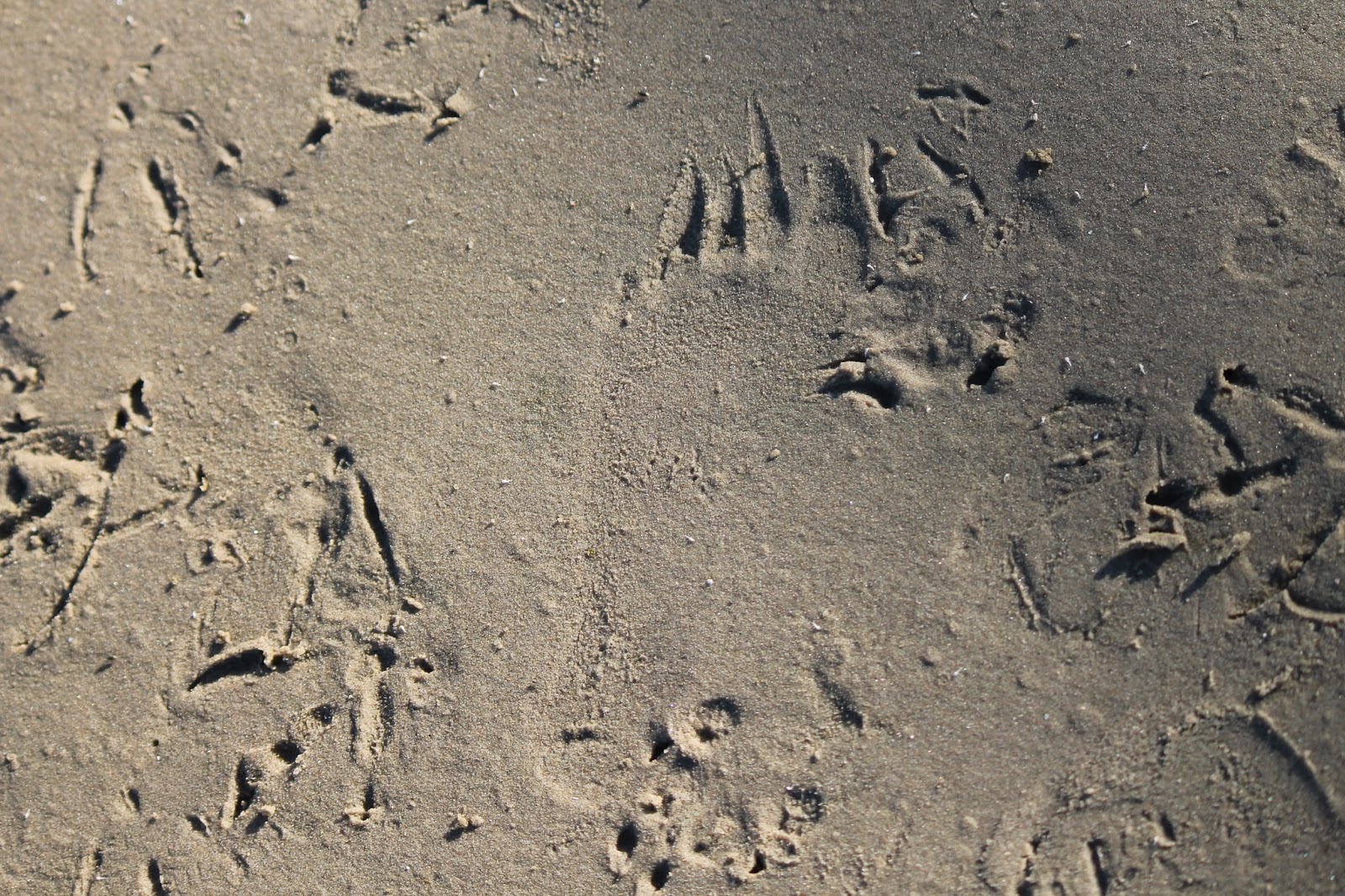
Mystery Tracks

I found these mystery tracks and am not sure what made them.

Track #1

Track #2
Track #3

Any guesses?  Post your thoughts in the comment section below.  Maybe we can figure this out!

September 2, 2013

Dragons & Damsels

I found this stunning little creature last Friday.  At first I thought it was a black butterfly, and fumbled with my camera to get a picture of it before it fluttered away. Much to my surprise, when I got home and put the pictures on the computer, I saw that this was a dragonfly.  Or so I thought.

Calopteryx maculata, resting on a poison ivy leaf.

When I researched a black-winged dragonfly, I was let to understand that this ebony beauty was really a damselfly.  Isn't that a great name?!  I picture a beautiful lady with sparkling, flowing scarves and a wind-billowed, shimmering dress standing on a castle rampart with her hair streaming behind her.

So what is the difference between a dragonfly and a damselfly?

Well, the biggest difference that I think would help a person identify them in the field is the way they hold their wings at rest.  Both dragonflies and damselflies have two pairs of wings.  However, a dragonfly will rest with his two pairs outstretched, and a damselfly holds hers upright, like a butterfly at rest.  (Hency my mistaken initial identification.)

Here is a dragonfly (below).  You can see how his wings are outstretched as he rests on the stalk of grass.

Libellula luctuosa, resting on tall grasses near a lake shore.

The damselfly (in the first photo) is an ebony jewelwing, and what an apt name.  It is lovely and shiny.  This one picture is a male.  The bodies of the males are more of a metallic green, and the females are more brown.  Their scientific name is Calopteryx maculata.  Calopteryx is from the Greek, meaning beautiful wing.  Maculata refers to the white spot the females have on the tips of their wings.

The dragonfly (second photo) is a male widow skimmer.  The males have white coloring at mid-wing, whereas the females do not.  His scientific name is Libellula luctuosa.  I had a hard time finding the etymology of Libellula, but it may be related to the Latin word for booklet.  Luctuosa has reference to mourning, and may be related to the black coloring on both the male and female.

September 1, 2013

Asiatic Dayflower

I was walking along a new trail in an urban park.  The cobweb factor was probably 7 out of 10.  The weeds on both sides were up past my elbows.   Then a splash of blue caught my eye.  Turning to look, I saw what I at first thought was a violet.


Hunkering down to get a closer look, I realized this was not just a common violet.  It was something special, and the only one of its kind as far as I could see.  It had two large blue petals, and what appeared to be tiny yellow flowers coming out of the center.  "That's different," I thought, and snapped away.  I felt like a real botanist at that moment!

Note the third flower petal, which is white, and is located behind the stamens in this photo.

When I came home, it was easy to google this unique flower and find out what it was.  It's an Asiatic dayflower.  These flowers last for only one day.  They bloom in the morning and do their best to attract pollinators with their showy yellow stamens, which I had at first taken for tiny flowers.

The Asiatic dayflower is an invasive species, but you can see why it was brought here.  It is very delicate and beautiful, and I felt like I had found a rare jewel.

August 28, 2013

Joke's On Me

A bright splash of color in the midst of a sea of green underbrush - what could it be? Determined to find out, I left the footpath and waded into the weeds, keeping my eye on the prize.

"It must be some new, rare flower - growing all alone like that," I thought, as I ignored the fact that most of the understory weeds I was passing through had leaves-of-three.

The closer I got, the brighter the "red blossoms" became.  I couldn't imagine what kind of exotic flower was flourishing there, beckoning to me in that shady, desolate spot.  I mentally cringed at all the poison ivy around me and pressed on.

Finally I found my prize.  Here's what I saw:

The rare paintius fluorenscus!

Yes, the joke was on me.  I had seen something bright and flashy alright - surveyor's marking paint - fluorescent pink!

I went on to find a number of plants that had been spray-painted in the area - mostly isolated weeds here and there, with no rhyme or reason that I could make out.


Eventually I found a few surveyor's ribbons marking this and that.  Something's up at the park, people!  I wonder what it is?

August 27, 2013

Ironweed

Ironweed is a plant I had never seen or heard of before, until I ran into it on the banks of the Mississippi River.  I was drawn to its deep purple blossoms.

This is prairie ironweed, as opposed to the similar tall ironweed.


Ironweed apparently takes its common name from its strong stem, and perhaps also from the rusty color of its faded blooms.


Its scientific name is Veronia fasciculata.  Veronia comes from the name of noted botanist William Vernon.  Fasciculata refers to the way the flowers are clumped closely together.  In tall ironweed the blooms spread out more widely.

This is a native plant, and is sometimes used in domestic flowerbeds.

August 25, 2013

Northern Leopard Frog

Frogs always leap away from me before I even know they are there, so I don't usually run into them or have much chance to photograph them, but yesterday was different.  There were two, and one scurried away over the edge of the stream bank.  The other one didn't go quite so far.


I was delighted to get any kind of picture at all, since amphibians are not my specialty.

Once home, I found that I had photographed a leopard frog.  They are pretty common in Iowa.  Leopard frogs have roundish spots scattered across their backs, and stripes on their legs.  To a novice like me, they look a lot like the more rare pickerel frogs, but pickerels have two fairly symmetric rows of square or rectangular spots running down their backs.


The light-colored line running from his eye to his back hip is called a dorsolateral fold. They have a similar line running from under their eye to their front shoulder.

These frogs are edible, but make sure you know what you have before you eat it, as some frogs are not.

August 24, 2013

Bucket List Gold

Ever since I started this blog, I have been wanting to get a bright photo of an American Goldfinch.  I have photographed goldfinches before, but they were in their duller, non-breeding plumage at that time.  Read that post here:  http://foundonthetrail.blogspot.com/2012/10/charmed-im-sure.html .

Today the lure of gold drew me out.  I headed out to a certain park of which I know, where there is exceptional goldfinch habitat (read:  seeds, Seeds, SEEDS!).

I parked my car, and got out.  I put the camera strap around my neck and took off the lens cap.  I was ready to go hunt down some goldfinches when - surprise, surprise - one came to me!

This fellow (it's a male) landed at the top of a tree right off the parking lot!  I wasn't even sure what it was when I aimed my camera that way, but to my delight, the zoom function brought into view this bright fellow:

Weighing about 1/2 an ounce, this goldfinch doesn't even weigh down this flimsy tree top.

My smile was wider than the my display screen, which showed his lovely black and gold.  What do you know?  Sometimes it's that easy.


This goldfinch didn't stick around long.  He had territory to defend, women to woo, and seeds to eat.  But I was thrilled with my capture and went on to enjoy a long ramble, knowing I had the goods on my memory card.

August 23, 2013

The White Duck Mystery

From my early elementary years on, I have always been a big Nancy Drew fan, and after reading about her mystery adventures, I always wanted to discover and solve a few of my own.  Well, on Wednesday, I bumped right into one.  I was walking out at Smith's Island and what did I see?  Two white ducks!


Now, I am an amateur bird watcher, but I do know enough to know that white ducks like this are not generally wild.  They looked exactly like your typical domestic duck found on a farm.  But what were they doing out here, in this wild marsh on the river?  I have walked this trail for three years and never seen a domestic duck here before.  How strange!

I took several photographs, and noted that they were swimming around very companionably with two mallard hens.  They were grazing on the plants at the bottom of the marsh, and spent more time with their heads under water than above.  I strained to see any markings of any kind that would help me identify them - if they really were some kind of wild breed.  Nada.  They were white, white, white, with orange bills and black eyes.  I decided that they had to be escapees from some nearby farm.

Quite curious by now, I contacted my ranger friend who works for the Army Corps of Engineers out there.  He revealed the mystery to me!  (Thank you, Ranger Steve!)


As it turns out, someone released this pair of domestic ducks at the marsh a few months ago, and they have been happily living there ever since.

Now, I've heard of kittens being dropped off on farms, but I've never heard of farms dropping off ducks at nature preserves before.  I'd love to know the rest of this story!  And, I am wondering how well they will winter.  Time will tell.

August 21, 2013

Pollen Baskets

I came across a field of pea partridge the other day, out at Nahant Marsh.  It is such a pretty plant that I couldn't help but stand there and admire the beautiful yellow flowers and the perfect, feathery leaves with their alternately compound pairs of leaflets.  I've blogged about it before, here:

As I took in the beautiful field full of flowers, I noticed a bumblebee by the plants nearest me, quickly buzzing into blossom after blossom.  That guy was fast!  He would no more than stick his fuzzy head into one flower when he would be off to the next, lifting himself as if on an elevator made of air.

I realized there were a few more bees nearby.  And then, as I lifted my eyes across the tops of the plants, I realized that the whole field was percolating with thousands of bees.  That did my heart good!


I decided to see if I could photograph one of the bees.  They were so fast that it was hard to get a fix on them before they moved on.  They were often obscured by portions of the pea partridge plants.  Finally I got a few decent pictures.


Even with my naked eye I was able to distinguish a yellow glob on the hind legs of the bees.  "That  must be pollen," I thought  Sure enough.  What I was seeing, and what you can see in these pictures, is thousands and thousands of grains of pollen packed into the pollen baskets that these amazing creatures are equipped with.

According to my research, bumblebees basicly lick their front legs and then use their front legs to brush all the pollen from their head and body down to their back legs, where it is pressed into the pollen basket.

Based on the size of the pollen globule on this fellow, he's been hard at work!

You can see the yellow, dusty pollen coating this bee's head, legs and body.

August 20, 2013

Lucky Shot

I was photographing egrets and herons at Nahant Marsh the other day, and as usual, when I got home and examined my photos up close, I found I had captured some unexpected wildlife.  It was a lucky shot, really.  Take a look:


Yep!  My very first raccoons caught on camera, and I didn't even know they were there!  Cast your net upon the waters and you never know what you will find.


These carnivorous mammals look cute from a distance but trust me - they are vicious, destructive animals.  Campers beware!  Do not sleep with food in your tent.  If you do, you are just asking for trouble, and raccoons will bring it without a doubt.  Thankfully these two were eating natural foods, and not garbage from a dumpster.

August 19, 2013

A Whole Lotta Egrets!

Nahant Marsh is a local treasure-box of wildlife.  They recently posted on Facebook that they had had an "abundance" of egrets and heron lately.  I was able to get out there last Friday morning, and was delighted when I pulled up in the parking lot and saw this view:


How cool was that?  Five white egrets all right there.  I couldn't wait to get out on the dock and get some closer photos.  I hurried down the mowed path through the tall grass prairie and out onto the dock, intent on getting some awesome photos.  Click, click, click went my camera.  Such great shots!  And then I paused and looked off to the northeast end of the marsh.  Lo and behold!


Wow!  I was stunned by the sheer number of birds out there.  There were so many that I laughed out loud!  There were at least fifty egrets and herons, all mixed together at that end of the marsh.  I only had my zoom lens and so couldn't get a wide angle shot but here are some close-ups:


I think it is funny that I was so focused on the first five egrets I saw that I almost missed seeing ten times that number.  I wonder how often we are like that in life - just focusing in on what we think is the prize, when there's lots more in store for us if we just open our eyes and look around.

Nahant Marsh is a cool place. It used to be a private shooting club, and all that lead shot (tons and tons of it) began poisoning the animals in the marsh. Eventually it was dredged and restored.  Now it is an absolute gem, with a hugely diverse population of plants and animals.

Here's a link to the amazing cleanup story of the Nahant Marsh:
 http://www.fws.gov/contaminants/documents/nahant_web.pdf

August 14, 2013

The Buzz on Bergamot

Today's post is about bergamot - a lovely, lavender wildflower - also known as bee balm.  It grows along wood lines and in abandoned meadows in large groupings, growing to 4 1/2 feet or taller.  It has many medicinal uses.


The name "bergamot" is an unusual name, and led me on a merry chase back as far as 550 B.C. to ferret out its etymology.

This native wildflower is a member of the mint family, and has a lovely and unique fragrance.  The fragrance reminded its namers of the similar smell of a completely unrelated plant - the bergamot orange.  And so our story begins.

The bergamot orange grows chiefly in southern Italy.  The fruit is the size of an orange, but it is greenish-yellow in color.  It has a bitter taste, so people don't generally eat it outright or juice it.  However, it is grown for its essential oils.  The unique aroma is, according to Wikipedia, evident in Earl Grey tea - much-loved by the famed Captain Jean-Luc Picard, of the starship Enterprise.


Back to my main theme.  The bergamot orange takes its name from the town of Bergamo, Italy, where - presumably - many of these oranges grow.

So how did the town of Bergamo get its name?  Let me tell you.  Bergamo comes from the Roman name of Bergomum.  And before it was latinized as Bergomum, it was called Berghem by the ancient celts who settled there.

And Berghem?  Berghem comes from the Old English (and prior to that the Proto-Germanic) "berg", meaning "mountain", and "hem" meaning "dwelling place".  Thus we have the origin for the name of this wildflower that grows innocuously on the Illinois savannas.  Who knew that such a little flower could have such a loaded name?

August 12, 2013

The Bluebird of Happiness That Wasn't

I was on a mission.  Hyperion & I were on a gator in the back forty at Loud Thunder, transporting critical fire-starting materials to our fellow campers. Suddenly we crossed paths with a stunning bird!  He sped into view and lit on the ground in front of us, looking for water in an old puddle.

"Look, it's a blue bird!" Hyperion shouted over the noise of the gator.

"Stop!  Stop!" I yelled, scrambling for my camera.  I had never photographed a bluebird before!

The bird hopped down the trail in front of us a couple of times and then soared into the treetops.


With our naked eyes, we thought it was a bluebird.  It certainly was blue. However, upon examining this digital image, I realized that no - this was not an Eastern bluebird!  They have brown breasts.  So what was it?  I noted the two-toned beak, with the upper beak actually curving, and the deeper bluish-purple on the head.  Purple is not a common bird color in the Illinois woodlands.  I soon discovered that this was an indigo bunting!

This one is a male.  The females are always brown.  The scientific name is Passerina cyanea.  A passerine is a sparrow or a sparrow-like bird.  Cyanea comes from Greek, meaning "dark blue" - you know, like the color cyan.  Indigo comes from another Greek word that stands for "dye from India".

So, in the end, this wasn't my bluebird of happiness.  Instead, it was my indigo bunting of happiness - a lovely jewel in the crown of my conclave weekend.

August 9, 2013

Mystery Solved

I have been wondering what this plant was for a while now:


Do you know it?


Every time I have seen it, I have photographed it, and then searched my field guides for it.  I tried googling it by putting in key words representing its most outstanding features.  No luck - until last week.


It's elderberry!

Most photos I've found on this plant online focuses on the white blossoms, rather than the beautiful, net-like appearance of its stalks and stems.

Elderberry a native plant, and is common in Iowa and Illinois.  It is an important food source for songbirds.  Deer, squirrels and mice also eat it.  Its scientific name is Sambucus.  While the plant can be poisonous, people do use the berries for food and to make drinks.  The wood has been used around the world to make musical instruments.

Elderberry has an amazing history, and I can't resist sharing with you a link to a super-informative online paper about elderberry for your further reading pleasure.  It was written by Charles E. Voigt, entitled "Elderberry, Herb of the Year 2013".  Here's the link:  http://jhawkins54.typepad.com/files/elderberry-hoy-document.pdf .

In his section on the history and lore of the plant, Voight states the following on the fascinating etymology of the name:

"Elderberry has been involved with human history for hundreds of years. Sambucus comes
from the Greek word “sambuke,” a musical instrument made of elder wood, whose music was
believed to heal the spirit. (In Europe, Elderberry wood was used for making musical
instruments.) The common name “elder” comes from the Anglo-Saxon “ellen”, meaning firekindler, because of the dry, pithy stems."

August 6, 2013

Two Leaves

I think these two leaves are both masterpieces - each in their own way.


Sometimes, I just can't get enough of leaves!

August 5, 2013

A Wren

This is Awren.

 She was named by a camp staff member out at Loud Thunder - quite cleverly too, I think.


She lives out at the Eco-Con shed, in a birdhouse.  She put up with weeks of Boys Scouts and Cub Scouts and church campers working and playing in close proximity to her home.  Perhaps this is why, as Jason tells me, that she was not afraid of people.  Reportedly, the only time she would fly away was if you actually looked directly into her birdhouse.

August 2, 2013

Brilliant Swamp Milkweed

This brilliantly-colored swamp milkweed caught my eye the other day:


I loved the deep pinky-purpose blossoms.


This was quite a tall and robust specimen.  Must be a great swamp!